

The Hidden B2B Buyer Behavior Gap That Results in 40 Percent of Lost Deals
B2B businesses are experiencing a decline in, or the abandonment of, deals. Nearly 40 percent of deals get canceled at the last moment before completion. Ledger Bennett, a B2B agency, surveyed B2B marketers across the US, UK, and APAC regions and found widespread dissatisfaction. More than 77 percent of marketers believe AI-related questions in RFPs (Requests for Proposals) are too weak or too superficial.
That’s the concern among leading and emerging B2B firms, whether their b2b customer understanding has any gaps. The major conflict arises with the hidden buyer gap, whereas every firm or agency is preoccupied with target buyers.
Get ready to dive deep into the other side of the target buyer, i.e., hidden buyers, concerns of marketers, and what could be the solutions to fill these gaps.
B2B buyer insights inside a shell cone
Buyer behavior insights are not visible. There are several reasons, but we will point to one. The journey of a B2B buyer doesn’t follow a single linear path. No longer will a buyer follow the traditional method of searching, clicking, dealing, and buying the products.
In the age of AI and the conversational internet, a B2B buyer’s journey involves reasoning, asking questions, understanding processes, and dealing with a large number of reviews and short summaries. Sales leads that come through marketing channels are not the only buyers.
Here comes the hidden buyers.
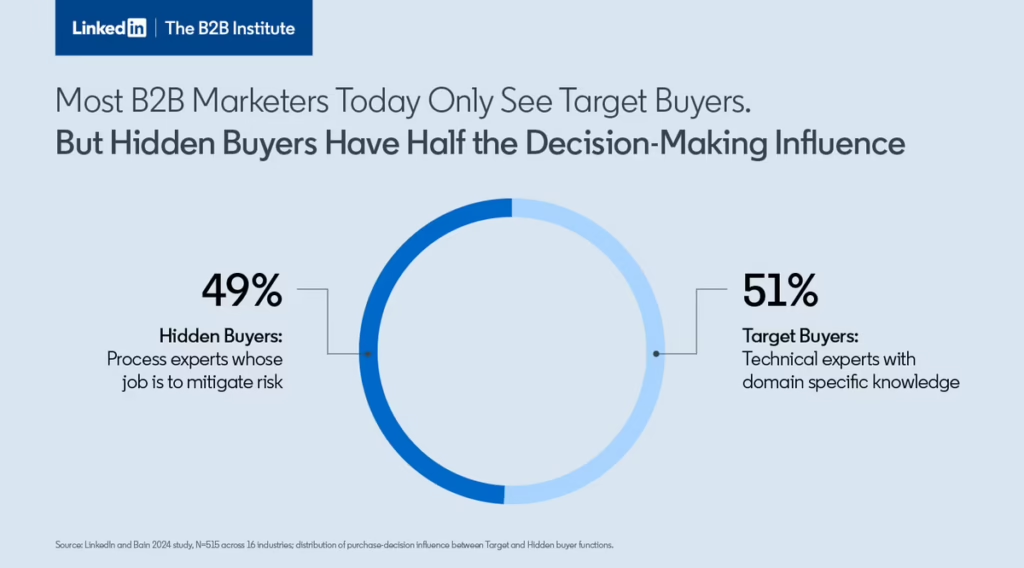
Hidden buyers represent the other side of the target buyers. These entities do not appear in meetings and demonstrations, but they are experts in their own leagues. They require more than a walkthrough and a testimonial.
They influence the decision of target buyers. AI-led products must go through layers of scrutiny from legal, finance, and operations, as nobody wants to have a $10 billion lawsuit on their shoulders.
Understanding this dynamic is the difference between a deal that closes and one that never reaches the finishing line.
Who are these hidden buyers, really?
While target buyers are the ones who show up for demo calls, download whitepapers, and click through gated content, hidden buyers work several departments away. Procurement checks contract terms. Finance checks math against the budget and forecast. Legal checks the fine print for liability. Operations check whether a new tool will survive in contact with existing systems and workflows.
LinkedIn’s B2B Institute, working with Bain & Company, put a number on this blind spot. Hidden buyers now carry close to half of the total decision-making weight inside an average buying group. Yet almost every dollar of B2B marketing spend is still built around the target buyer alone, tracked closely because it leaves a visible digital trail — webinar sign-ups, ad clicks, CRM touchpoints.
The B2B Institute frames this as a perception problem before it becomes a strategy problem, comparing it to how people can get trapped by seeing only one image in an optical illusion. Marketers, they argue, stay “trapped in a single, limiting view” of who the buyer really is, simply because that’s the view the CRM was built to reward.
That is the real story behind fallen deals. It usually isn’t that the target buyer changed their mind. It’s somewhere between legal review and a finance sign-off.
B2B companies fail to understand customers
Ledger Bennett’s research points to a harder truth underneath all this. Most B2B brands lose deals because they lack a deeper understanding of their audience and fail to adapt to its behavior, which keeps shifting.
Two forces are compounding the problem simultaneously. Buying committees are growing more complex, with more internal stakeholders weighing in long before a vendor gets a seat at the table. And AI is changing where evaluation actually happens. Buyers are increasingly turning to AI-generated summaries and comparison tools before any human conversation begins, which means a brand can be quietly ruled out of consideration without a single person on the marketing team knowing a deal was ever in motion.
This is where the earlier statistic on weak AI-related RFP questions stops being just a number and becomes a symptom. If marketers themselves can’t write sharp, specific questions about how a vendor AI actually works, hidden buyers certainly aren’t getting satisfying answers either.
Unsatisfying answers at that stage are exactly how deals fall apart in the final stretch, after months of what looked like solid progress.
The AI bubble burst’s impact on businesses makes this worse
There’s a wider anxiety sitting underneath all of this. As conversations about the possible impact of a burst AI bubble on businesses grow louder across boardrooms, buyers in finance and procurement have become noticeably more cautious about AI-related claims. They’ve seen inflated ROI promises before. They are now the ones asking vendors to prove, in writing, that an AI feature won’t quietly create liability six months down the line.
That caution is already reshaping how AI vendors have to sell.
In an earlier Ad Pulse conversation on how compliance fits into AI-powered content creation, Adclear AI’s Joe Jordan made a point that applies well beyond financial services: even with AI doing the heavy lifting, “humans are the last gate” before anything goes out the door.
That single line captures exactly what a hidden buyer wants to hear from a vendor — not that AI is being avoided, but that a human is still accountable for what it produces.
How B2B companies can improve customer understanding
Ledger Bennett’s follow-up research lays out a more practical path forward, built around four questions every B2B team should be asking before greenlighting another campaign:
- What information actually helps a buyer move forward, and how does that differ across an executive sponsor, a technical evaluator, and a finance stakeholder?
- In what sequence does that information need to arrive? Most deals don’t stall because information is missing — they stall because the right information shows at the wrong moment.
- How does buying intent build and fade across the full sales cycle, not just across the digital touchpoints marketing can actually see and measure?
- What specifically causes decisions to stall in the real world — internal misalignment, unresolved risk, thin proof points, or a late-stage stakeholder nobody accounted for?
Addressing the full buying committee, rather than a single champion, isn’t a nice-to-have anymore. Research presented at LinkedIn B2Believe found that brands doing this generate over 50 percent more leads than those still building campaigns around a single persona.
Practically, this means B2B customer insights can no longer live in a single team’s inbox. Sales need to flag where legal or procurement pushed back, and why. Product needs to feed marketing the objections that keep resurfacing in late-stage calls.
And content — the whitepapers, the case studies, the RFP responses — needs versions written specifically for a risk-focused reader, not a repurposed version of whatever target buyers already saw three stages earlier.
Cut to the chase
Nearly 40 percent of B2B deals fail quietly, near the finish line. Fully understanding B2B buyer behavior, hidden buyers included, may be the only real differentiator left in categories where every vendor claims to do exactly the same thing.