

Why Creativity, Human Judgment, and Failure Still Matter in Marketing
Creativity Under Constraint: As timelines shrink, platforms standardize formats, and AI accelerate production, creativity is increasingly shaped by limitations. This series explores how marketers are redefining creativity under pressure, working within algorithmic rules, legal boundaries, and performance demands while still producing work that resonates.
Marketing teams are under pressure to produce more, move faster, and prove results. AI is accelerating that pressure, but better tools alone cannot solve the problem. Creativity still depends on how people think, respond to failure, and challenge familiar assumptions.
Felix Riley, business strategist and former BBC comedy writer, believes organizations need to rethink those assumptions. For him, Riley, the challenge goes beyond technology. Failure, cultural differences, and artificial intelligence may appear to be separate concerns, but all three are shaped by the assumptions people bring to their work and the limits they place on what they believe is possible.
In this interview, he discusses learning from failure, building stronger global teams, and why human creativity and judgment will matter as AI takes on more routine work.
- Creativity under pressure: Why marketers need to challenge assumptions as timelines shrink and AI accelerates production.
- Learning from failure: How treating unsuccessful experiments as data can improve decision-making.
- AI and the human edge: Why creative thinking, judgment, and empathy remain valuable as routine work becomes automated.
- Global team culture: How organizations can build a shared identity without erasing cultural differences.
- Storytelling and innovation: How stories can help teams challenge limiting beliefs and think more ambitiously.
Learning from failure to improve creative work
Marketing teams are expected to experiment, innovate, and deliver results. Yet when unsuccessful campaigns or ideas are treated as evidence of poor performance, employees may become less willing to take creative risks.
Riley argues that changing how organizations perceive failure can help people approach experimentation differently. An unsuccessful attempt can reveal what needs to change, where assumptions were wrong, and whether a different approach is worth pursuing.
How can marketers use failure as a learning opportunity to improve their campaigns and approach new ideas with greater confidence?
Felix Riley:
“The entire attitude towards experience changes for the better. Most of life involves failing.
“When you pick up a guitar for the first time, you fail for weeks or months before you can strum tunes. Watch a child learn to walk. They fail for six months or a year, and then they succeed. Yet we have this idea that failure is inherently bad.
“I have two grown-up girls, and I said to them as they grew up, ‘The definition of failure is not even trying. If you try, you haven’t failed. You’re already a success in my books. Once we try to enter the race, we might not succeed according to the measure we have set for ourselves or that others have set for us. That result is data. You learn from it and try again with that knowledge. You may also realize that you should be doing something else.’
“Nelson Mandela said, ‘I never fail. I either win, or I learn.’ That is my attitude towards failure.”
For marketers, this perspective offers a different way to approach campaign testing and creative experimentation. An idea that fails to meet its original targets can still reveal something about audience preferences, messaging, or the assumptions behind a strategy. The value lies in understanding the result and using it to inform the next decision.
Building a shared identity across global teams
Creative work is shaped by the experiences, expectations, and cultural contexts people bring to it. For global marketing teams, these differences can influence how audiences interpret messages and how employees approach problems.
Organizations need shared goals and a common sense of direction, but establishing them does not require everyone to think or work in the same way.
How can global organizations preserve cultural differences while building a shared identity across countries?
Riley:
“We do not realize how heavily our environment influences us.
“I grew up on a council estate where cultural expectations were very low. If you compare that with growing up in an affluent area, where everyone attends private school, the parents have successful careers, and children expect to have great careers themselves, those children have very different starts in life.
“We understand the difference between rich and poor in Britain, but the principle applies around the world.
“I have worked in copper mining in Zambia, where many of the people I met had a rather beautiful attitude. They simply wanted enough money to put food on the table and to take Friday night off. They were not concerned with acquiring things. A global organization should celebrate these differences and learn from them, while finding a common language that pulls the company together.
“People should be able to celebrate being Danish, Norwegian, or Zambian and keep that identity alive within their part of the company. At the same time, everyone needs a common language that unifies them and helps them recognize that their differences are a tremendous benefit to one another.”
For marketing leaders, the distinction matters when coordinating teams across markets. A shared brand strategy can provide consistency, while local knowledge and cultural understanding help teams develop messages that resonate with different audiences. Recognizing those perspectives can also broaden the range of ideas available to a team.
Scaling AI takes more than better models. Discover why governance, operating models, and organizational change determine enterprise AI success through more in-depth analysis and executive interviews from CTO Magazine.
The human skills that matter as AI advances
AI is changing how organizations approach routine work, from documentation and communication to content production and analysis. But faster execution does not eliminate the need to understand problems, evaluate options, and make decisions in uncertain situations.
Riley expects AI applications to become more useful as organizations find practical ways to apply the technology. He also argues that businesses should pay closer attention to the human capabilities that complement automation.
As AI takes on more routine work, which distinctly human capabilities will become more valuable?
Riley:
“AI will eventually prove exciting and useful, but much of the current discussion is hype. It is machine learning, and AI is a marketing term.
Large language models have peaked, and we are now entering the application stage. The apps built on top of those engines will continue to improve and become genuinely useful.
“A lot of routine work will disappear, but I do not believe AI will take everyone’s jobs. Some companies will mistakenly try to use it that way. Certain tasks will be automated, which should free people to use their human edge.”
Felix RILEY, Former MANAGING Director at MF Global
If I go into a law firm, I am happy for it to use a strong AI system in the background for documentation and communication. I still want a person who can think creatively and innovatively about my problem, give me confidence, and guide me through the ambiguity of the legal process.
The less routine work we have to do, the freer we are to use our human qualities. The smartest companies and law firms are already recognizing that they need to develop people’s human skills because those abilities will become increasingly valuable.”
Using storytelling to challenge limiting beliefs
Creative thinking can be constrained by more than budgets, deadlines, or technology. Established assumptions about what is possible can also prevent individuals and teams from exploring better approaches.
Riley uses storytelling to help people recognize these limitations and reconsider how they approach challenges. Rather than simply telling people to think differently, he believes stories can help them identify the assumptions shaping their decisions.
When people leave your talks, what do you hope they take away from the experience, and what would you like them to start thinking or doing differently?
Riley:
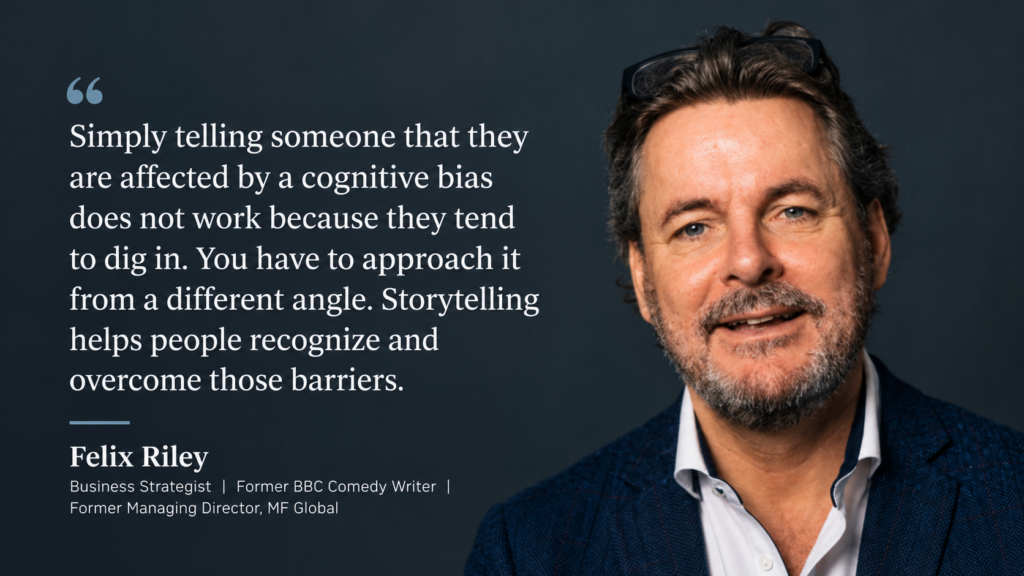
“I realized that cognitive biases and limiting beliefs were holding them back. Simply telling someone that they are affected by a cognitive bias does not work because they tend to dig in. You have to approach it from a different angle. Storytelling helps people recognize and overcome those barriers. Creativity gives them a route towards bigger thinking.”
“When I speak at companies, I deliver my keynote and then lead a workshop where people produce fantastic ideas because their thinking has changed. I want people to leave with much more belief in themselves, much more belief in their organizations and a stronger sense of what they can achieve as a team.”
For marketing teams, storytelling can be useful beyond the campaigns they create for customers. It can also help teams question familiar approaches, communicate new ideas, and explore possibilities that established processes might otherwise rule out.
The challenge for leaders is to create opportunities for employees to test their assumptions and contribute ideas without feeling that every unsuccessful attempt will count against them.
What Felix Riley’s insights mean for business leaders
Riley’s perspective connects several challenges facing marketing organizations as AI changes how work gets done. Technology can accelerate execution, but the quality of the outcome still depends on the decisions people make, the assumptions they question, and the context they bring to their work.
His argument about failure has implications for how marketing teams experiment. Campaigns and creative ideas will not always deliver the expected results. Teams need ways to assess those outcomes, identify useful lessons, and apply them to future work. Without that learning process, the pressure to deliver predictable results can discourage experimentation.
His comments on cultural differences also highlight the importance of balancing consistency with local understanding. Global brands need recognizable identities, but teams benefit from the perspectives and experiences of the people working in different markets. A shared strategy can provide direction without requiring every team to approach its audience in the same way.
AI adds another dimension to these challenges. As automation takes over more routine tasks, marketers will need to make effective use of the capacity it creates. That means developing the creative judgment, contextual understanding, and decision-making skills needed to guide AI-assisted work toward meaningful business outcomes.
Storytelling offers a way to bring these ideas together. By helping people recognize limiting assumptions and consider different possibilities, it can support both creative work and organizational change.
Ultimately, Riley’s message is that progress depends partly on what organizations believe their people can achieve. Businesses that make room for learning, encourage different perspectives, and develop human capabilities will be better positioned to turn new technologies and ideas into meaningful results.
About the author: Felix Riley is a business strategist, keynote speaker, former BBC comedy writer, and novelist. He founded and sold ChoiceOdds before becoming Managing Director at MF Global, where he served on its Global Executive. For more than a decade, he has advised organizations on ambitious growth, challenging limiting beliefs, and developing human potential. He is also the author of two novels published by Penguin.