

Campaign of the Quarter: Adobe’s Firefly Reaches out to Skeptical Creatives
You’ve probably seen Adobe’s latest campaign across YouTube, Instagram, and LinkedIn. Featuring creators like Kinigra Deon and Airrack, the videos highlight Firefly as part of the creative process rather than a replacement for it.
Behind marketing, Adobe is quietly banking on Firefly becoming infrastructure that most professionals can’t work without. Adobe is expanding its reach beyond brands and agencies to include enterprises and creators. As the creator’s economy continues to grow, the move makes strategic sense. But their latest Firefly push is about more than promoting AI-Powered creative tools.
The timing is intentional. Marketers are drowning in content demands. Creators are nervous about both looking generic and many are rebelling against complete creative automation. Against that backdrop, Adobe is taking a shaky risk: running a marketing campaign positioning Firefly as a tool that fits into existing creative workflows rather than replacing them.
This campaign is Adobe’s attempt to address all three challenges at once. More importantly, it’s a signal of how the company plans to compete in an increasingly crowded AI landscape alongside users who are skeptical at best.
Marketing has a content production problem
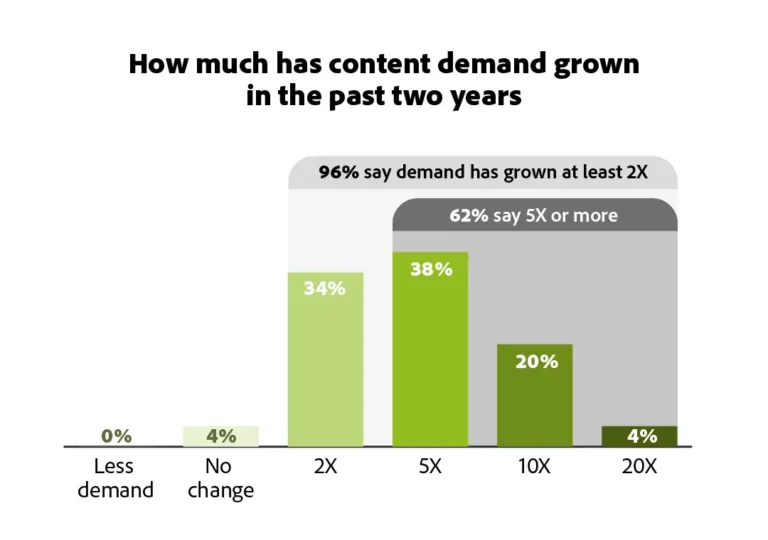
The numbers explain why we’re closely following Adobe’s new campaign. Adobe’s research notes that 62 percent of marketers said content volume rose sharply over the past year. Most expect demand to grow five times over by 2026.
Every new channel adds more versions to make: more sizes, more languages, more cuts built for AI search tools instead of people. Old production models can’t keep pace. Over half of organizations told Adobe their content supply chain is still slow and linear. That gap is exactly where Firefly is positioned to step in.
Generative AI seemed like the ideal solution for lots of brands. With a surge in demand for content, AI could provide an effortless way for brands to create additional content and meet demand. Unfortunately, solving the volume issue was only a part of the overall problem — and content creatives are overwhelmingly rejecting AI.
Early AI tools delivered speed. They didn’t deliver quality control. In Adobe’s 2026 Creators’ Toolkit survey of over 16,000 creators, most say AI helps them work faster. But more than half also say their AI drafts need real editing before they’re publish-ready. On the enterprise side, three out of four organizations cite data and integration problems as the biggest barrier to scaling AI further.
Former Mastercard CMO Raja Rajamannar has gone further, warning brands against what he (and many) call “AI slop,” loosely defined as low-quality, mass-produced content created by genAI. Speed alone was never an issue. Authenticity and context were priorities. Brands needed AI that fit their existing workflow, not AI that created a new one.
Adobe’s venturing into perilous ground by trying to win over a community of those who are shunning AI in their work, but we’re also looked at this campaign as an interesting litmus test for the future of creative work + collaborative tools.
Adobe’s playbook for generative AI and creativity collaboration
This is where the campaign earns its keep. Instead of presenting Firefly as a replacement for creative work, Adobe shows it handling specific tasks inside existing workflows.
The message is important: AI is most useful when it removes friction, not when it tries to replace human touch and creativity altogether. Gigi Robinson uses Firefly Boards to build mockups before a shoot. Val Zhang uses it to remove crowds from background shots, and to generate full videos. Pablo Rochat uses it to create images from scratch, and to sketch ideas on Boards before he starts anything else.
Adobe VP Stacy Martinet has summed up the pitch simply: scale shouldn’t cost a creator their voice. The same logic plays out at enterprise scale, too. Newell Brands used Firefly Custom Models trained on its own packaging to cut Paper Mate production time by 75 percent.
Disney trained a custom Firefly Foundry model on its own characters including Frozen, Moana, Lilo & Stitch, Cars, to help Imagineering sketch and prototype new rides. Imagineering’s senior VP Kyle Laughlin says the tool has cut out the “back and forth” that used to drag concept work into months.
Adobe Turns to Disney to Shoot for AI Creativity With Control
Disney’s enthusiasm for Firefly comes with a huge catch: total control over its own IP. The same company training custom AI models on its characters is also suing Midjourney and MiniMax for breaching IP. It’s sent Google a cease-and-desist over alleged copyright infringement, too.
Adobe’s Custom Models are built to train only on assets a brand actually owns. The problem is that most of the industry isn’t there yet, and doesn’t have hundreds of years of examples to train a full AI model. Adobe’s research found that while most organizations claim to have AI governance policies, fewer than half say those policies are consistently followed. That growing tension is responsible for Adobe’s enterprise strategy significantly diverging from many of its AI competitors. The discussion of AI’s capabilities has progressed far beyond merely how AI can create to now include what data was used to train the AI model, who owns the resulting produced materials, and if brands may implement this technology without a risk of legal or reputational harm.
Along those lines, ownership and governance provide many brands with an advantage in competing with one another. Adobe is selling brands a solution that enables them to create massive amounts of creative content while at the same time providing them assurance, they will not lose control over their intellectual property.
What’s the future of genAI in design and creative work?
Adobe’s next challenge is making the AI disappear into the workflow entirely. Their long-term goal isn’t to make creators think about AI more often. It’s to make AI feel like a natural extension of the tools they already use every day.
None of the creators in Adobe’s campaign treat Firefly as a replacement, a friend, a saviour. They talk about it as one tool in a bigger kit. Dentsu’s chief creative partner Octavio Maron put it bluntly: “[AI] is not a replacement for taste, judgment, or originality.”
Most creators surveyed say the final creative call should always stay with them, no matter how capable the AI gets. Adobe heard that. Throughout the campaign, Firefly is presented as a creative assistant rather than a creative replacement—helping creators move faster while keeping creative judgment firmly in human hands.
What would make them trust an AI agent with more responsibility? Mostly the basics: the ability to review, edit, or undo its work, visibility into what it’s doing, and limits on what data it can touch. Additionally, creators claim that when AI frees up time, they would want to use it to hone creative direction or acquire new abilities rather than just create more material.
In April 2026, it launched a Firefly AI Assistant. Creators describe an outcome in plain language. The assistant handles the steps across Photoshop, Premiere, Lightroom, and Express. A new partnership with NVIDIA pushes this further, building next-generation Firefly models and brand-accurate 3D tools for marketing teams. Adobe’s research says that organizations expect agentic AI to help with research and internal workflow tasks within 18 months.
Far fewer expect it to generate campaign content outright. While Adobe is racing to make Firefly indispensable before cheaper, creators in this campaign are the friendly face of a larger intellectual war between AI companies and the users they seek to target.