Debunking 8 Retail Media Myths That Cost Brands Growth
Retail media, once viewed as an e-commerce channel, has evolved into a more influential marketing ecosystem. It now shapes product discovery, brand awareness, and omnichannel measurement.
CPG, DTC, and localized brands have recognized this.
According to EMARKETER, 73 percent of advertisers plan to increase their retail media investments in 2026, while U.S. retail media ad spending is projected to reach $69.3 billion this year.
Yet nearly 90 percent of that spending will flow to Amazon Ads and Walmart Connect, highlighting how concentrated and competitive retail media networks have become.
Despite this explosive growth, many marketers still rely on decade-old assumptions about retail media. The industry has changed. Consumer journeys have changed. AI has changed campaign execution. These myths need debunking.
This article covers eight of the most significant ones.
Myth 1: Retail media is only for the bottom of the funnel
Retail media built its reputation for closing sales. Sponsored product listings, search placements, and performance metrics made it synonymous with conversion marketing.
But reality has changed.
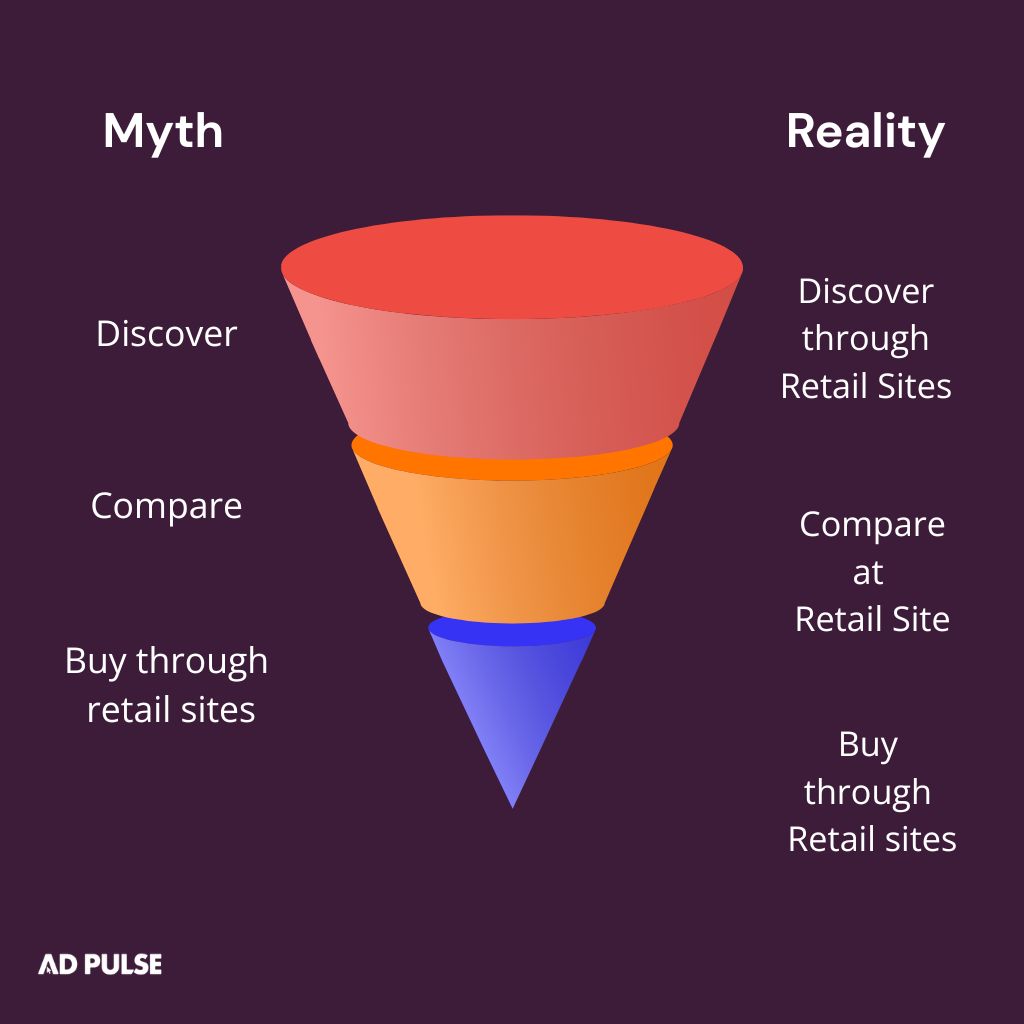
Retailers are rapidly expanding beyond onsite search into video, Connected TV (CTV), livestream shopping, off-site display advertising, and in-store digital experiences. Commerce media is becoming a full-funnel ecosystem where consumers discover, compare, research, and eventually purchase products.
Brands increasingly use retail media to launch products, tell stories, and stay visible throughout the buying journey. Awareness no longer happens elsewhere before consumers arrive at a retailer’s website. It often begins inside retail media itself.
Myth 2: Retail media is just another performance marketing channel
Performance remains one of retail media’s biggest strengths, but reducing it to ROAS misses its broader value.
Retail media offers something most advertising channels cannot: deterministic first-party shopping data tied to actual purchasing behavior. As third-party cookies continue to disappear and privacy regulations reshape targeting, that data has become one of the industry’s most valuable assets.
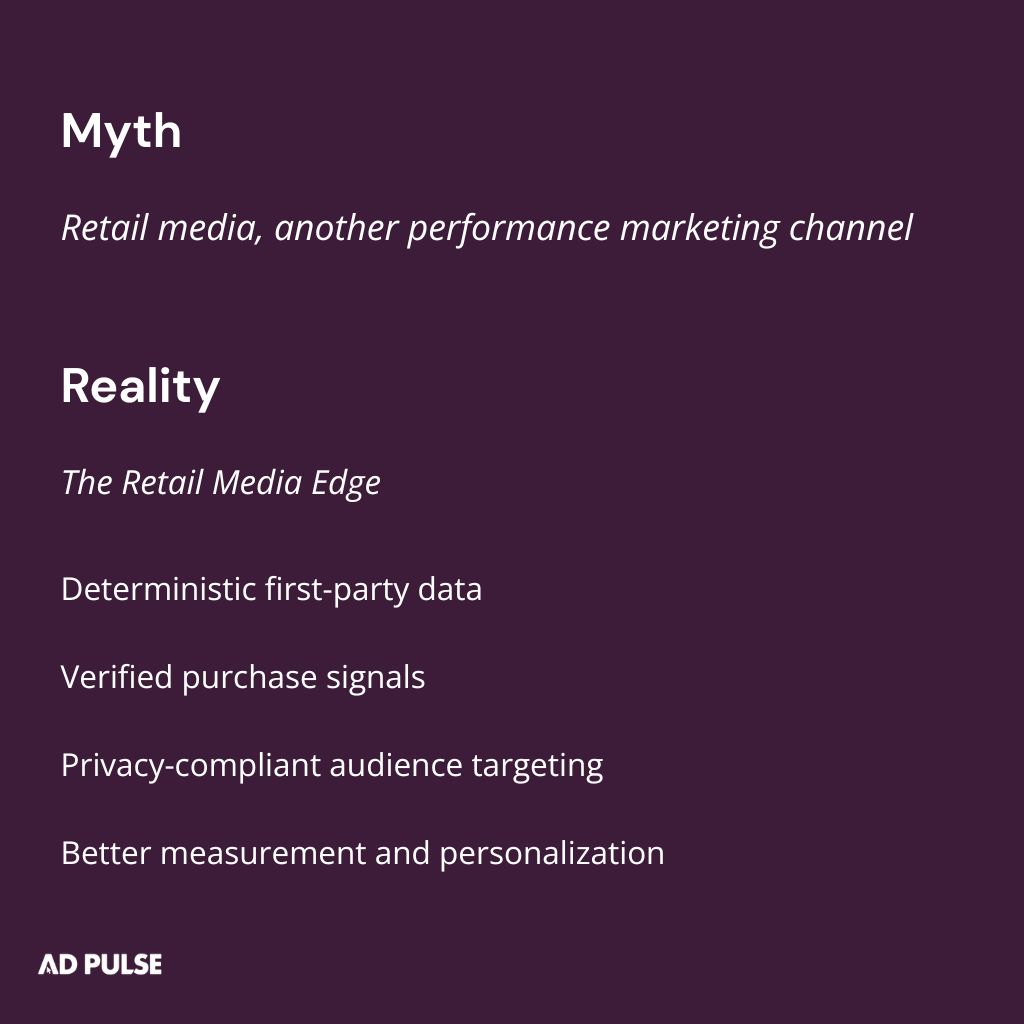
Today’s marketers are buying intelligence with clicks.
Retail media is increasingly influencing assortment planning, creative optimization, pricing strategies, and customer segmentation. Instead of functioning as an isolated advertising channel, it is becoming part of the broader marketing operating system.
Myth 3: Bigger budgets automatically deliver better outcomes
Retail media spending is rising rapidly, but more spending doesn’t automatically translate into growth.
As more advertisers compete for premium inventory, maintaining efficiency becomes harder. The brands seeing consistent returns are often those investing in better creative, cleaner product information, stronger first-party data, and continuous experimentation rather than simply increasing bids.
AI has accelerated this shift. Campaign optimization, bidding, and audience allocation are increasingly automated. Human advantage now lies in supplying algorithms with better creative assets, richer customer signals, and clearer business objectives.
Success depends less on spending harder and more on spending smarter.
Myth 4: Sponsored listings are retail media
Ask someone to describe retail media five years ago, and they’d probably mention sponsored products.
Today, that is only one piece of a much larger ecosystem.
Retail media now stretches across:
- Connected TV
- Digital out-of-home
- Retailer apps
- Livestream commerce
- Social commerce integrations
- Programmatic display
- In-store digital screens
- Shoppable video
Retailers are evolving into media companies. Some are even experimenting with entertainment-led commerce, where branded content blends naturally into the shopping experience instead of interrupting it. Recent initiatives from retailers and consumer brands show how storytelling is increasingly entering retail environments rather than remaining confined to television or social platforms.
The conversation has shifted from retail media to commerce media, and that distinction matters.
Myth 5: Retail media only works for large CPG brands
Large consumer packaged goods companies helped build retail media, but they no longer dominate the opportunity.
Direct-to-consumer brands, challenger brands, subscription businesses, financial services, travel companies, and even B2B organizations are exploring retail media networks to reach highly qualified audiences.
The expansion is being driven by richer audience signals rather than product categories.
Retailers understand purchase intent at remarkable levels of detail. That intelligence can benefit brands far beyond grocery shelves.
The winners won’t necessarily be the largest advertisers. They’ll be the ones who connect retailer insights with their own customer data to create more relevant experiences.
Myth 6: ROAS tells the whole story
Retail media has always celebrated measurable performance, but marketers are beginning to realize that return on ad spend is only part of the puzzle.
A campaign can produce an attractive ROAS while failing to acquire new customers, improve lifetime value, or generate incremental demand.
As retail media matures, brands are paying closer attention to metrics like:
- Incrementality
- New-to-brand customers
- Customer lifetime value
- Share of category
- Brand lift
- Repeat purchase behavior
Measurement itself is evolving from attribution toward business outcomes, and the next challenge is making sense of the enormous volume of data.
Ironically, retail media’s greatest challenge today isn’t generating data, it’s making sense of the volume.
Myth 7: Every retail media network deserves your budget
The explosion of retail media networks has created another misconception—that brands need to advertise everywhere.
In reality, marketers are becoming more selective.
EMARKETER projects that nearly 90 percent of new U.S. retail media spending in 2026 will be captured by Amazon and Walmart, reflecting advertisers’ preference for platforms with proven scale, measurement capabilities, and mature technology.
Meanwhile, dozens of smaller retail media networks continue competing for attention.
This doesn’t mean emerging networks lack value. It simply means brands should evaluate retail media based on audience fit, measurement quality, first-party data, and strategic objectives—not because every retailer has launched an advertising platform.
Scale alone no longer guarantees success.
Myth 8: Retail media is already mature
Perhaps the biggest misconception is the belief that retail media has reached its final form.
If anything, the industry is entering its next phase.
AI agents are beginning to influence product discovery. Commerce media is extending into streaming television. Clean rooms are improving privacy-safe collaboration. Retailers are integrating loyalty data into advertising, while measurement continues moving toward incrementality rather than last-click attribution.
Industry observers increasingly describe retail media as still in its adolescence rather than its adulthood. The foundations are established, but standards, interoperability, and measurement continue evolving rapidly.
The biggest changes may not come from new advertising formats at all. They may come from AI reshaping how consumers search, compare, and purchase products before traditional ads even enter the equation.
Cut to the chase
Retail media’s story is no longer about replacing search or taking leftovers from social media spending. It’s becoming the connective tissue between commerce, content, customer data, and AI-powered decision-making.