
5 Warning Signs Brands Can’t Ignore About AI in Marketing
Brands entered 2026 making high-value bets over AI. CEOs and CMOs threw off the reins on AI and let it take over departments, including marketing and advertising. Budgets expanded; human forces cut down, workflow realigned in accordance with C-suite orders.
Right now, the first half of 2026 (H1) is about to be over. The returns of AI for H1 will start making headlines in the upcoming weeks. Before that happens, brands must look at another side of AI in marketing.
The efficiency and speed are real while generating content and filling up the pipelines. Nevertheless, the oversaturation, authenticity, consumer trust and skepticism of what’s being served have echoed louder than before.
We, at Ad Pulse, have identified five major trends from H1 about AI in marketing that will help marketers and brand strategists to ponder in the coming weeks.
5 H1 trends necessitate a review for AI in marketing
The first half of 2026 has not invalidated AI in marketing. It demands a review from brands’ sides. The tech industry is facing tumultuous times while praising and supporting AI injunction through reports and trends.
1. AI spending budget is breaking economics
The AI investment is not small for brands. 70 percent of CMOs express their need for becoming an AI leader in 2026 but only 30 percent have supportive infrastructure, processes, and maturity to scale investment effectively.
That gap between spending and readiness is where the economy starts to crack. On one side, 15 percent of marketing budgets are pouring in AI initiatives while on the other side, more than half of CMOs say they do not have the budget required to execute their strategy.
If we put marketing aside, there are companies such as Uber, Microsoft, big tech orgs facing budget discipline. It emerged as an unexpected challenge in the AI era. Just months ago, companies actively encouraged employees to use AI as much as possible, treating heavy adoption as proof of innovation for executives and investors alike.
The more AI people use, the better. But that resulted in racking up heavy bills against the companies.
The current spending spree on AI is unsustainable in its current form for many companies. The race to deploy AI capabilities is leading to a situation where the cost of inference and training is becoming a primary driver of AI strategy.
2. ROI and Productivity not figured out
According to Jasper’s State of AI in Marketing 2026 report, 91 percent of marketers now actively use AI in their work — up from 63 percent the previous year.
When asked to prove what that usage is worth, the consensus fractured. Last year, 49 percent of marketers said they could prove AI ROI. It is not because AI is delivering less value, but because productivity gains alone are no longer sufficient. Leadership now expects AI investments to show up in measurable business outcomes.
Ad Pulse’s own reporting surveys found that 82 percent of B2B marketers have seen no impact on their compensation from their AI skills, and 70 percent are self-funding their AI education with no employer support.
3. Content oversaturation
Consumer enthusiasm for artificial intelligence is declining rapidly, with only 19 percent of users in 2026 saying they feel excited about AI, down from 50 percent just two years ago.
The shift comes from an analysis by TRG Datacenters, which examined thousands of high-engagement posts across more than seven online communities. The study identified three major pain points driving what many now describe as “AI fatigue.” The most visible: an explosion of low-quality, repetitive AI-generated content, commonly referred to as “AI slop.”
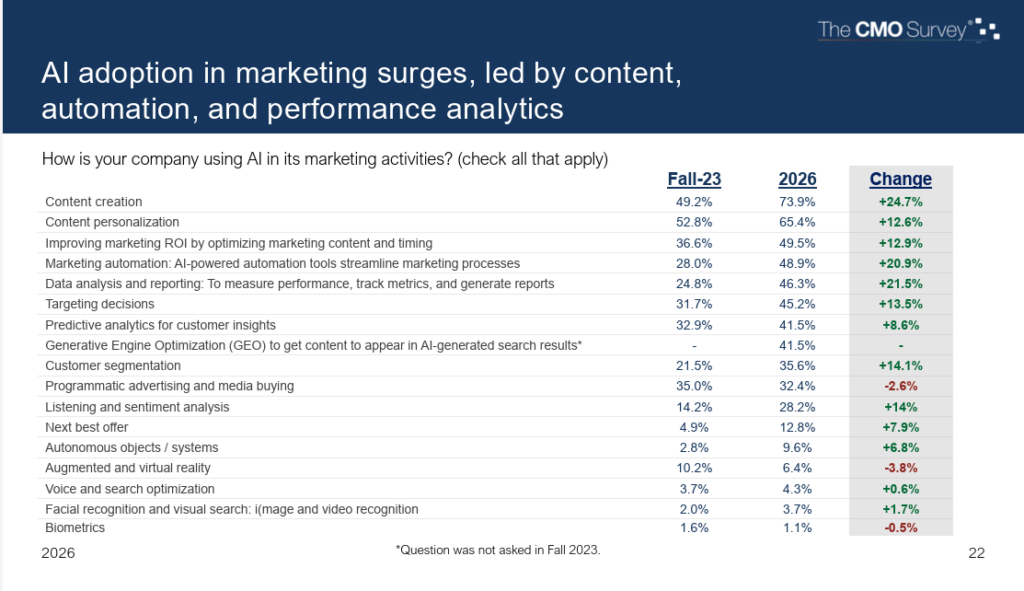
The volume context explains why. As of 2025, 74 percent of newly created web pages contain some AI-generated content, according to an Ahrefs study of 900,000 pages. Because the quantity is so large, it congests recommendation systems, making it harder to encounter truly high-quality content.
Consumer sentiment is described by those inside the industry as a “massive reset,” with brands more willing than before to embrace creators’ imperfections.
4. Consumers trust reviews and not AI recommendation
Consumers are using AI, but using is different from trusting — and the gap between the two is exactly where brand strategy has been making its assumptions.
Klaviyo’s 2026 AI Consumer Trends Report, which surveyed 8,000 global consumers across eight markets, found that only 13 percent of consumers completely trust AI. 36 percent trust it, and 30 percent are neutral.  Even among those who do engage with AI for shopping, the trust architecture is conditional and segmented.
This skepticism is pushing users toward platforms perceived as more authentic, particularly community-driven spaces. Many consumers now rely on forums like Reddit to verify reviews and gather opinions, rather than trusting polished brand messaging or marketplace feedback.
5. Young and digital-native consumers want AI disclosure in ads
The generational divide on AI in advertising is getting wider — and the advertising industry’s assumptions about it are consistently wrong.
IAB’s January 2026 research, “The AI Ad Gap Widens,” found that 83 percent of ad executives now say their company has deployed AI in the creative process — up from 60 percent in the 2024 study.
Gen Z are heavy personal users of AI tools. Their skepticism about how brands deploy it is informed, not reflexive.
On disclosure, the data points to an available solution that most brands are not using consistently. Among Gen Z and Millennial consumers, 73 percent said knowing an ad was AI-generated would either increase or have no negative effect on their likelihood to purchase. Clear disclosure is the third-highest driver of attention for AI ads, behind only high-quality visuals and humorous content.
The gap between what consumers is asking for and what brands are doing is not a creative problem. It is a decision brands have not yet made.
Check and balance must be in place
The first half of 2026 has exposed something the marketing industry spent the last two years avoiding. AI is no longer a novelty that deserves investment simply because competitors are investing. It has become another business capability that must justify its costs, prove its impact, earn consumer trust, and fit within a sustainable strategy.
None of the five trends suggest brands should pull back from AI. They suggest brands should become more disciplined in how they use it. Budget efficiency is replacing AI spending races. Business outcomes matter more than productivity claims. Human creativity is becoming more valuable as synthetic content floods the internet. Trust is shifting toward communities rather than algorithms. And transparency is emerging as a competitive advantage rather than a compliance exercise.
Cut to the chase
Five emerging trends of AI in marketing will likely give heads up to brands and marketers. Going in the second half of 2026 should be less about AI adoption and more about how and where to put AI in the processes.