
Email Deliverability in 2026: Best Practices to Keep Your Emails Out of Spam
You are all set for your email marketing campaign. The subject line is interesting; the offer is appealing, and the design has been executed flawlessly. You’ve hit send, expecting clicks, leads, and sales. However, there is one problem: the emails might not turn up in the inbox at all.
Emails designed to generate revenue may end up in spam folders or get blocked by email service providers. For marketers, this is more than a technical issue. It threatens campaign performance, customer loyalty, and marketing ROI.
Email deliverability in 2026 is no longer just about avoiding spam-trigger words or choosing the best time to launch a campaign. Email providers are enforcing stricter sender requirements, monitoring sender’s reputation, and using sophisticated filtering systems to determine which messages reach the inbox.
Google is ending the phase of gradual enforcement of requirements for senders that started in November 2025, and therefore compliance has become extremely important for companies sending emails in bulk.
So, how can marketers improve email deliverability in 2026?
The answer lies in combining technical compliance with relevant content, responsible email list management, and continuous performance monitoring.
Why is Email deliverability important in 2026?
At a Glance
- Authenticate your domain: Configure SPF, DKIM, and DMARC to help email providers verify your messages.
- Protect sender reputation: Monitor spam complaints, bounce rates, and sending activity to maintain trust.
- Keep subscriber lists clean: Remove invalid addresses and regularly review inactive subscribers.
- Prioritise relevant content: Use audience segmentation and personalised messaging to encourage meaningful engagement.
- Monitor inbox placement: Track deliverability metrics and make unsubscribing simple to reduce spam complaints.
Email deliverability refers to an email’s ability to reach its intended recipient without being rejected, blocked, or filtered into spam. However, an email marked as delivered by a marketing platform has not necessarily reached the recipient’s primary inbox.
This distinction matters because the delivery rate and the inbox placement rate differ. A campaign can report a high delivery rate while a significant percentage of its emails land in spam.
In 2026, there are some changes that have made deliverability crucial:
- Stricter sender requirements: Big companies now want strong sender validation and a low rate of spam complaints from bulk senders.
- Sophisticated spam detection: Email providers now not only care about technical aspects but also integrate client feedback and sender activity.
- Focus on engagement: Irrelevant campaigns and messages to uninterested subscribers damage the sender’s image.
The financial ramifications are huge. When email communication doesn’t reach the right people, marketers miss opportunities to nurture leads, recover items left in shopping carts, advertise products, and retain current customers.
The objective now is no longer to send more emails. It’s to make sure appropriate messages land in the correct inboxes.
1. Email authentication is now non-negotiable
One of the major paradigms regarding email deliverability in 2026 is the growing importance of email authentication. Email providers require proof that email messages come from the domain they claim to come from.
Email Authentication: SPF vs. DKIM vs. DMARC
These three protocols work together to help verify email senders, protect domains from spoofing, and give mailbox providers instructions for handling authentication failures.
SPF
Sender Policy Framework
SPF identifies the mail servers authorized to send email for a domain. Receiving servers check the sender’s IP address against the domain’s SPF record.
DKIM
DomainKeys Identified Mail
DKIM adds a cryptographic signature to outgoing emails. Receiving servers can verify the signature using the public key published in the domain’s DNS records, helping confirm message integrity and domain association.
DMARC
Domain-based Message Authentication, Reporting, and Conformance
DMARC checks whether SPF or DKIM passes with the required domain alignment. It lets domain owners specify how receiving servers should handle messages that fail DMARC and receive reports about authentication activity.
SPF checks the sending server. DKIM verifies a cryptographic signature. DMARC applies domain-alignment rules and communicates the domain owner’s policy.
In the case of bulk sending over 5,000 messages a day to personal Gmail accounts, Google has laid down certain requirements with respect to the SPF, DKIM, and DMARC settings, along with appropriate alignment of sending domain and the domains of authentication. Marketing messages are to provide for one-click unsubscribe mechanisms.
What about marketers? They need to make an audit of all domains used for campaigns, newsletters, workflows, and email services of third parties. It is also important to make sure that settings are properly done, and DMARC reports are being received.
2. Sender reputation: Your email program’s trust score
The sender’s reputation refers to the level of trust that mailbox providers have in your sending domain and IP address. It works like a credit score, as a good sending reputation will be built through sending relevant emails, while a bad one is built through spam complaints and other sending irregularities.
The sender’s reputation is affected by various factors such as:
- Highly unsuccessful email delivery and spam complaint rates.
- Sudden rise in the number of emails sent.
- Low engagement of inactive subscribers.
- Authentication issues.
Example: The inactive subscriber problem. Imagine an online retailer sending weekly promotional emails to a list of more than 100,000 subscribers (about the seating capacity of the Los Angeles Memorial Coliseum), including thousands who have not engaged in months. This wastes resources and can increase delivery risks.
The solution involves two steps: segment subscribers so that active customers receive relevant promotions and run targeted re-engagement campaigns for inactive contacts. Subscribers who remain inactive can then be removed from routine promotional sends.
Making use of Google postmaster tools, it is possible to check whether the mailing list is being sent out to opted-in receivers.
The key takeaway: A smaller, engaged email list can be more valuable than a larger, unresponsive one.
3. Email spam filters are getting smarter
Modern email spam detection goes beyond suspicious words and links. Email providers use techniques such as machine learning, sender behavior analysis, and other signals to identify unwanted messages.
For marketers, avoiding words such as “free” or “sale” is no longer enough. Instead, they should focus on the following:
- The sender should be easily recognized, and the e-mail should have a consistent e-mail address;
- The content provided in the e-mail shall include reliable links, and the subject line shall be relevant;
- The e-mail should be mobile-friendly with clearly readable content;
- The message should be in line with subscribers’ expectations.
What will change in 2026? AI-assisted inboxes are changing how emails are filtered, organized, and retrieved. Marketers should prioritize useful, personalized content over generic mass emails—for example, software updates tailored to customers’ interests and needs.
4. One-click unsubscribe is a deliverability best practice
Making the unsubscribe process complicated can frustrate recipients and encourage spam complaints. An easy opt-out process improves the subscriber experience and helps protect sender reputation.
Gmail requires qualifying bulk senders to provide one-click unsubscribe functionality for marketing messages, alongside a clearly visible unsubscribe link. Yahoo also requires easy unsubscribe options for bulk senders. Gmail recommends processing requests within 48 hours (about 4 days).
Any companies sending emails should be doing the following:
- Helping users with one-tap unsubscribe headers
- Make an unsubscribe link easy to locate
- Quickly react to requests for unsubscribing
- Help users control the emails they receive
- Remove people from the mailing list once they unsubscribe from it
Remember: Losing an uninterested subscriber is better than damaging your sender’s reputation.
5. How to improve email deliverability: 7 best practices
Practices for Improving Email Deliverability in 2026.
Email Marketing Guide
7 Practices for Better Email Deliverability in 2026
Reach more inboxes with a healthier sender reputation.
Configure SPF, DKIM, and DMARC correctly to help mailbox providers verify your emails.
Avoid purchased lists. Remove invalid addresses and maintain a clean, permission-based database.
Tailor campaigns to subscribers’ interests, preferences, and engagement history.
Stick to a predictable sending schedule and avoid sudden, unexplained volume spikes.
Offer one-click unsubscribe where applicable and process requests promptly.
Check authentication, bounce codes, spam-folder placement, and sender reputation before scaling campaigns.
Track spam complaints, hard bounces, delivery rates, clicks, conversions, and open rates.
6. Email deliverability Rate vs. Inbox placement rate
A high delivery rate can be misleading because emails may be accepted by receiving servers but filtered into spam instead of reaching the inbox.
According to Validity’s 2026 Email Deliverability Benchmark Report, the global inbox placement rate reached 87.2%. This figure provides a useful industry reference, although results vary by industry, region, and mailbox provider.
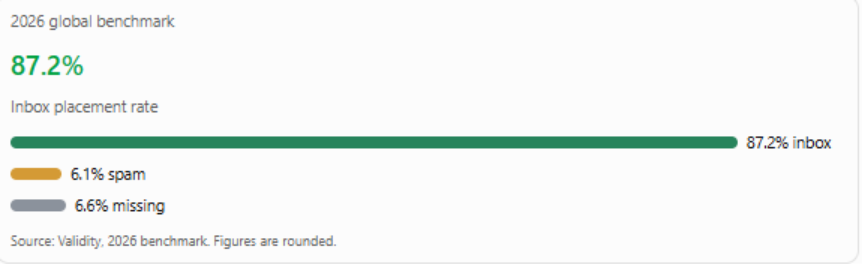
Figure mentioned above are not set benchmarks, as they may be different based on an industry and a mailbox provider.
Google recommends that bulk senders keep their spam complaint rate below 0.1% and prevent it from reaching 0.3% or higher. Marketers should monitor inbox placement and spam complaints alongside delivery rates to gain a clearer picture of campaign performance.
7. The expert perspective: Relevance is the real competitive advantage
Technical compliance is essential, but it cannot compensate for irrelevant content. Marketers must ensure their emails reach the inbox and provide genuine value to recipients.
According to Validity’s 2026 benchmark report, it is important to measure whether actual messages have reached the inbox rather than relying solely on delivery statistics.
Marketers should be asking themselves the following questions regularly:
- Do recipients desire this message?
- Is the sender domain authenticated?
- Is the audience interacting with the email?
- Is it easy for users to unsubscribe?
- Are emails producing valuable results?
These questions help turn email deliverability from a technical issue into a marketing priority.
Cut to the chase
Successful email deliverability in 2026 depends on strong sender reputation, proper authentication, clean subscriber lists, and relevant content. By prioritizing trust and engagement, marketers can improve inbox placement and achieve better campaign results.
FAQ’s
Email deliverability refers to the ability of an email to reach a recipient’s inbox rather than being filtered into spam or blocked by an email service provider.
Marketers can improve email deliverability by setting up SPF, DKIM, and DMARC authentication, maintaining clean subscriber lists, sending relevant content, monitoring sender reputation, and making unsubscribing easy.
Email delivery rate measures how many emails reach the recipient’s mail server, while inbox placement rate measures how many successfully reach the inbox instead of the spam folder or other filtered locations.