Deepfake Influencer Ads: Who Pays the Price When AI Fakes an Endorsement?
Imagine scrolling through Instagram when an influencer you know pops up in a commercial for a beauty product. The ad appears utterly real, as the influencer’s look, voice, emotions, and manner of speaking are all attributes their millions of fans know them for. They talk about the product and its advantages, urging everyone to purchase it. However, one thing is wrong: the influencer hasn’t made the ad.
They had never tried the product, agreed with the script, and got into a partnership with the brand. Still, the audience watches, spreads the message, and buys the product because they trust the endorsement’s authenticity. Meanwhile, the influencer has come up with an explanation for how their face ended up promoting something they have never used.
Thus, the question is no longer whether AI can create effective advertisements. The real question is who is to be responsible when AI misuses someone’s identity and turns it into an illegal advertisement?
As technology advances in AI-generated videos, synthetic voice generation, and digital replicas, the risks associated with deepfake marketing are rising.
The state of the law as 2026 nears is not helping businesses, marketers, influencers, and media platforms use synthetic content.
What is a deepfake influencer?
Deepfake influencers are people whose faces, voices, expressions, or other recognizable characteristics are altered or recreated using AI technology. Using this technology allows people to create content that appears to be someone endorsing a product or making a statement they never made.
There are different types of deepfake technologies utilized in influencer marketing.
- Celebrity deepfakes: Using AI technology, a celebrity appears to promote a product without their permission.
- Cloned influencer advertisements: An influencer’s voice and likeness are used in order to advertise a brand that has never collaborated with the influencer.
- Tampered with sponsored content: A company alters an influencer’s videos without the influencer’s consent.
- False testimonials: A person talks about the results of using a product which they have never tried in real life.
Nevertheless, it’s important to recognize that not every digital influencer is a deepfake. Brands can establish fictitious personalities in their promotional strategies. The legal concerns differ when those characters create imitations of recognizable individuals, allege endorsements from people who did not approve, or use dishonest product information.
The most serious problem is that deepfake commercials violate the principles of influencer marketing, which is based on credibility. Followers appreciate influencers because their opinions seem authentic, and once this trust is destroyed, a single ad can lead to either a breach of credibility for the company or general damage to the entire industry.
Who is responsible for an unauthorized deepfake advertisement?
When a deepfake advertisement goes viral, accountability extends beyond the creator of the video. It is possible that different parties can be implicated in the situation.
Brand or advertiser: Any entity that has commissioned, validated, or knowingly spread an unauthorized deepfake may incur liability under likeness rights laws, misleading advertisement rules, intellectual property regulations, or contract laws.
Advertising firms or AI developers: Since advertising companies and freelancers can be involved in creating and distributing unauthorized content and in misusing their rights, they can be liable depending on the actions they took, the agreements they signed, and the applicable law.
Social media network: Social networks may also be required to address unlawful content in accordance with relevant legislation. In India, the IT Act and the IT Rules set out requirements for intermediary due diligence regarding illegal online content. It should be acknowledged that liability does not arise on every occasion.
The individual masquerading as the influencer: A person who mimics a creator’s identity in bad faith could be liable in court, depending on the actions taken and the applicable law.
The main idea is that responsibility cannot be attributed to a single responsible party in every situation. Investigators and courts may examine who created, commissioned, approved, or published the advertisement, what each party’s role was, and whether explicit permission was granted.
Can an influencer sue over a deepfake ad?
Indeed. An influencer has the right to file a lawsuit if their identity or content is being used without their permission. The claims vary based on the specific jurisdiction and facts of the case. Some of the claims involve:
- Right of publicity: Unauthorized commercial exploitation of an individual’s name, likeness of image, voice, or identity.
- Copyright infringement: Copying or altering copyrighted works like photographs and videos made without the permission of the copyright owner.
- Breach of contract: When a company exceeds the permitted usage amount stated in the agreement.
- False endorsement: A promotional campaign presents false assumptions about the individual’s endorsement with a certain brand.
- Privacy actions: When the case meets the criteria of applicable privacy laws.
For instance, a vlogger using video footage for a specific beauty brand might take issue with the company’s use of AI to develop a similar promotional clip for other products.
To substantiate claims of intellectual property rights violations, content creators must save images, websites, timestamps, and publication contracts to ensure there is a legal basis for commercial use.
An attorney representing the creator in litigation may offer advice on the possible solutions.
Is it legal to use someone’s likeness in an AI-generated ad?
There is no universal yes-or-no answer. Laws vary across countries and, in the United States, across states. However, using AI to reproduce a real person’s recognizable identity does not automatically make the use lawful.
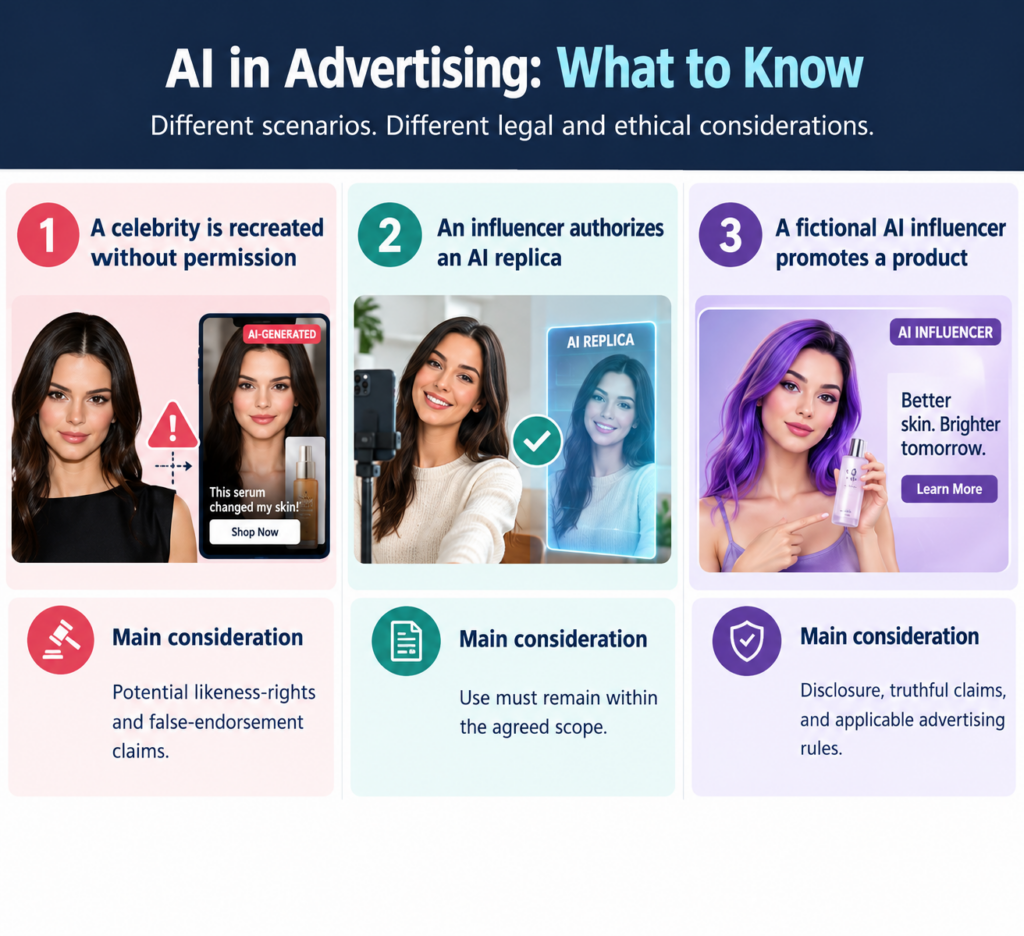
Consent is not an absolute concept. A person may agree to voice paraphrasing but refuse to allow the creation of synthetic recommendations or advertisements for rivals.
AI influencers can be very useful for companies, but they must avoid imitation and deception. No artificial person should pretend to be a real one and mislead the public about what it can advertise.
Celebrity deepfake ads: Fraudulent endorsements and deception
An investigation by WIRED found TikTok ads featuring AI-generated celebrities such as Taylor Swift and Kim Kardashian endorsing a fake rewards program. This example clearly demonstrates how deepfakes exploit celebrity influence to deceive audiences.
New York’s AI advertising disclosure regulation
As of June 9, 2026, New York’s synthetic performer regulation requires clear disclosures in advertisements involving AI-generated human performers.
How do deepfakes affect influencer marketing?
Deepfake ads present an issue that goes beyond legal issues.
- Audience trust erosion: When a consumer is exposed to a deepfake ad, they may become unsure of genuine endorsements.
- Damage to brand partnership: Advertisers might begin to doubt whether the influencer has advertised competing products, even if that creator is a victim.
- Consequences for actors and businesses: Influencers may need to hire lawyers and make public statements, while brands could face complaints.
- Even more complicated verification: Since marketing departments cannot assume that knowing a person or voice means the endorsement is genuine, verification should be included in campaign planning.
How can brands prevent unauthorized Deepfake advertising?
Brands can reduce their risk by establishing safeguards in their campaign strategies.
1. Revise influencer contracts. Specify the use of AI in reproducing the influencer’s likeness, voice, generating news imagery, modifying appearances, translating the performance, or licensing digital replicas. Include restrictions on use, payment, and termination conditions.
2. Require authorization for alterations in any material. Approving the original content does not automatically approve any changes made with AI. Institutions should have written authorization processes for the modifications to images, context, or implied endorsement.
3. Ensure that permission was obtained before releasing anything into the public domain. Verify that the influencer or an authorized representative has approved the latest advertisement. Have a record of the licenses, resources, and approved versions.
4. Apply deepfake detection technologies cautiously. Detection technology can alert users about questionable videos or computer-generated voices, but it is not flawless. It should be used along with human oversight and creator verification.
5. The disclosures must be made in an understandable manner. Whenever necessary, it is essential to state the names of performers created using artificial intelligence or synthetic content to make the disclosure clear and understandable. Disclosures cannot substitute for consent, and misleading claims are prohibited.
6. Establish a plan for quick response in cases of misleading audiences. Collect documents, inform platforms or lawyers when necessary, and issue an easily understandable correction in case of misleading audiences.
The future of influencer marketing depends on consent
Business use of artificial intelligence can help promote messages to audiences, create ambassadors, and implement marketing strategies more effectively. However, the activity’s efficiency can be achieved only with consumer consent.
It should always be remembered that an individual’s facial and vocal identity is not freely available for any commercial use, even if it can be generated with the help of AI. The authorization for the use of the said video does not mean that one has been authorized to carry out unlimited endorsement using synthetic marketing in connection with it.
New legal and regulatory updates in 2026 reinforce the basic lesson learned by brands: they need to understand the uses they are allowed to make of their ads, the audience’s expectations regarding the ad, and the effectiveness of AI-generated ads if they cross legal parameters.
Ultimately, the question is not whether AI can make an influencer look real. It is whether the endorsement is genuine, authorized, and truthful. When an advertisement is never authorized, the consequences can be very real.
Cut to the chase
The emergence of deepfake advertising has blurred the line between genuine endorsements and AI-generated fakes, raising critical questions about consent, trust, and rights over digital likenesses.
Companies, agencies, and platforms should ensure they have the appropriate permissions to use deepfake technologies and adhere to ethical practices when deploying artificial intelligence.
FAQ’s
Yes. An influencer may take legal action if their face, voice, likeness, or content is used without permission. Possible claims include violation of publicity rights, copyright infringement, false endorsement, breach of contract, or privacy violations, depending on the jurisdiction and circumstances.
Not automatically. Using someone’s recognizable face or voice in an AI-generated ad may require their permission. The legality depends on applicable laws, the scope of consent, and whether the advertisement creates a misleading endorsement.
Responsibility may extend to the brand, advertiser, advertising agency, AI content creator, platform, or individual who created the fake. Liability depends on each party’s involvement, knowledge, permissions, and applicable laws.
At a Glance
- Deepfake advertising can damage trust: AI-generated endorsements can mislead consumers and weaken confidence in genuine influencer recommendations.
- Consent is essential: Brands cannot assume that permission to use original content also allows AI-generated alterations or digital replicas.
- Legal responsibility can be shared: Brands, agencies, creators, and platforms may face different forms of liability depending on their roles.
- Disclosure matters: Advertisements featuring AI-generated performers may need clear disclosures under applicable regulations.
- Brands need stronger safeguards: Clear influencer contracts, written approvals, deepfake detection, human oversight, and rapid-response plans can help reduce risks.