

Brand Loyalty vs. Price: Are Consumers Finally Choosing Deals Over Their Favorite Brands?
A customer has been using the same shampoo for five years. They know its fragrance, trust its quality, and rarely consider alternatives. However, one day he visits a shop and learns that another brand offers a 30% discount on its goods. Therefore, the previously chosen product suddenly loses its significance.
The same situation applies to smartphones, groceries, clothing, streaming services, and even luxury products. No matter how strongly consumers connect with their favorite brands, their purchasing decisions can change when household budgets tighten, and competitors offer more attractive deals.
This raises an important question for marketers: Does a customer remain loyal because they genuinely love a brand, or because they have not yet found a better price?
Brand loyalty remains valuable, but businesses can no longer take it for granted. Consumers are becoming more price-conscious, actively searching for better deals and questioning whether their favorite brands justify the extra cost.
This puts businesses in a difficult spot. While lower prices can bring in consumers, extreme discounts can hurt brand reputation and make people wait for the next sale.
We will learn more about the relationship between brand loyalty and price sensitivity, why loyal customers switch brands for better deals, the impact of discounts on purchase decisions, and how businesses can retain loyal customers without constantly cutting prices.
What is brand loyalty, and why does it matter?
Brand loyalty refers to a customer’s consistent preference for a particular brand, developed through positive experiences, product quality, reliability, trust, and emotional connections.
As an illustration, if a person has an inclination toward acquiring Apple technology, the brand can prevail in light of the interconnected products and services provided by Apple, user-friendly features, high quality, and satisfaction with being an Apple customer.
Similarly, consumers may prefer Nike because of its product design, performance, and strong brand identity. However, brand loyalty does not mean customers will never consider competing products.
In some cases, customers can love a specific brand but switch to another brand when:
- A rival has significantly lower prices.
- A brand increases prices while not improving quality.
- Discounts and bonuses offered by the competitors are more attractive.
- A customer learns about other similar products that cost less but bring more benefits.
- A customer’s financial situation alters.
The important distinction is that brand preference does not always translate into purchasing behavior. Customers may genuinely like a brand but still choose a competitor when the alternative makes more financial sense.
What is price sensitivity in consumer behavior?
Price sensitivity refers to how strongly consumers change their purchasing decisions when the price of a product or service increases or decreases.
For example, consumers can show high sensitivity to buying certain bottled water rather than an expensive one and continue using the smartphone of their choice if it is effective and trustworthy.
This shows that price sensitivity varies across consumers. There are several determinants of consumers’ price sensitivity as follows:
1. Income and consumer buying capability: Consumers who have limited disposable income are likely to compare the prices on products and look for discounts.
2. Product availability: When many brands offer almost the same products, consumers will be able to make comparisons and make substitutions easily.
3. Perceived quality of product: Consumers may accept high prices when they are convinced that the product is effective, durable, or reliable.
4. Brand recognition: A well-known brand can also justify a certain price level by giving consumers the feeling of confidence in their purchase.
5. Buying frequency: Price differences are most evident when consumers buy something repeatedly, like groceries, cleaning products, or other everyday products.
A 2026 consumer trend worth watching: Capgemini’s What Matters to Today’s Consumer 2026 report, based on 12,000 consumers across 12 countries, found that 74% would switch brands for lower regular prices. This shows that brand loyalty alone may not justify higher prices.
Consumers increasingly expect value for money, making competitive pricing essential for retaining customers.
Brand loyalty vs. price: Why are consumers choosing better deals?
Increasingly complex dynamics are developing loyalty and price sensitivity. Customers do not necessarily turn away from brands they like; rather, they become pickier about when to buy.
Here are five key reasons why people tend to switch brands more often in search of savings.
A. Rising living costs are changing purchasing priorities
Rising living costs are making consumers more cautious about their spending. As household budgets become tighter, shoppers are increasingly reconsidering premium products and exploring more affordable alternatives, including supermarket private-label brands.
As stated in Ibotta’s 2026 State of Spend report, 62% of customers care more about price than brand name, while 44% tend to buy more store brands than last year, highlighting how financial pressure alters buying habits.
B. Consumers can compare prices more easily
Consumers once relied on local stores, advertisements, and recommendations to discover alternatives. Today, e-commerce platforms, price-comparison websites, coupons, and social media make it easier than ever to compare brands.
For example, a consumer may prefer Nike running shoes but switch to another brand offering similar features at a lower price. This puts established brands under pressure as customers increasingly prioritize overall value over brand preference.
C. Discounts make competitors more attractive
Discounts can encourage consumers to try unfamiliar brands by reducing the financial risk of switching. For example, a 25% discount on a competing detergent may persuade a loyal customer to try an alternative. If the product meets their expectations, they may continue purchasing it even after the promotion ends.
A 2026 CouponFollow survey found that 61% of shoppers switched to a brand they discovered through a price promotion. Furthermore, 80% of respondents said that they had delayed making their purchases in anticipation of a discount on the product they wanted.
This means that discounts not only create sales but can also convert loyal consumers into regular customers of rival brands.
D. Consumers no longer believe that expensive always means better
Premium pricing used to suggest quality and exclusivity, but consumers are starting to wonder whether a product’s high price means it performs better. Private-label products have also improved and become more competitive with well-established brands.
According to research by Ibotta, only 38% of consumers believe national brands offer better quality than private-label brands. This is down from 44% in the previous year.
The brands should now demonstrate their superiority rather than relying solely on reputation.
E. Loyalty Is becoming more conditional
Brand loyalty among today’s consumers does not preclude switching to competing brands if better opportunities arise. Modern customers require brands to offer competitive value rather than just be recognized brands.
According to a report published by Inside Retail in September 2026, 91% of Australian consumers have shifted brands due to advantageous offers, and 79% have gone to a different retailer to capitalize on a particular promotion.
The conclusion: Brands need to demonstrate their value consistently to retain customers.
How do discounts influence consumer buying behavior?
In four significant ways, reductions affect the decision to buy:
1. They create impulse buying: People feel obliged to make purchases under time-limited offers and do not think of postponing buying things.
2. They facilitate product testing: When prices are lower, people are encouraged to buy products from brands that they haven’t tried yet.
3. They develop deal-seeking habits: Customers begin to think that they can wait for promotions instead of buying things at their prices.
4. They establish temporary loyalty: Discounts may persuade people to buy things repeatedly, but they will change the seller if they find better deals in other places.
According to CouponFollow’s recent research conducted in 2026, 73% of consumers said they are loyal only to brands that often offer discounts, while only 5% would remain loyal to a company that does not reduce its prices even when competitors are offering 20% discounts.
In short, discounts can attract customers, but a heavy reliance on them may erode brand loyalty.
Why do loyal customers switch brands?
Having loyal customers does not guarantee that they will stay forever. Even long-term customers may abandon a brand when it no longer meets their expectations or delivers sufficient value for money.
As an illustration, long-term smartphone customers switch to competitors when the price of one model increases, even when no new features have been added.
The most common reasons people switch brands are:
- Unjustified price increases. Higher price with no extra value.
- Better offers of competitors. Attractive prices and features.
- Poor product quality. Customers have multiple disappointments.
- Bad customer experience. Late order delivery, difficult returns, and ineffective support.
- Changing needs. Products no longer meet people’s expectations.
Capgemini’s consumer market research conducted in 2026 shows that 71% of customers would switch brands if their current brand increases prices or reduces product size or quality without communicating with customers.
What is the most direct cause of customer loyalty?
The foundation of customer loyalty is consistent satisfaction, trust, and perceived value. When a brand consistently delivers on its promises, customers have stronger reasons to return. For example, a 40% discount may encourage someone to try a new product, but poor quality can prevent them from purchasing again.
Essential components of customer loyalty formation are the following:
1. Quality of products and services.
2. Trust and openness.
3. Positive interaction with customers.
4. Emotional ties with a brand.
5. Reasonable prices.
6. Good rewards and recognition systems.
The conclusion is that customer loyalty cannot just be bought through discounts but requires a solid experience.
Sam Gilding, CRO at Vypr, warned that brands can no longer take customer loyalty for granted, as shoppers increasingly switch for better offers. He cautioned that frequent discounts may create a promotional cycle rather than lasting loyalty.
Does price promotion reduce brand loyalty?
Not necessarily. Price promotions can strengthen or weaken brand loyalty depending on how businesses use them. The difference lies between strategic promotions and excessive discounts.
Dennis McCarthy, CRO at Bread Financial, highlighted the importance of offering flexible solutions that help shoppers manage budgets and feel confident about purchases.
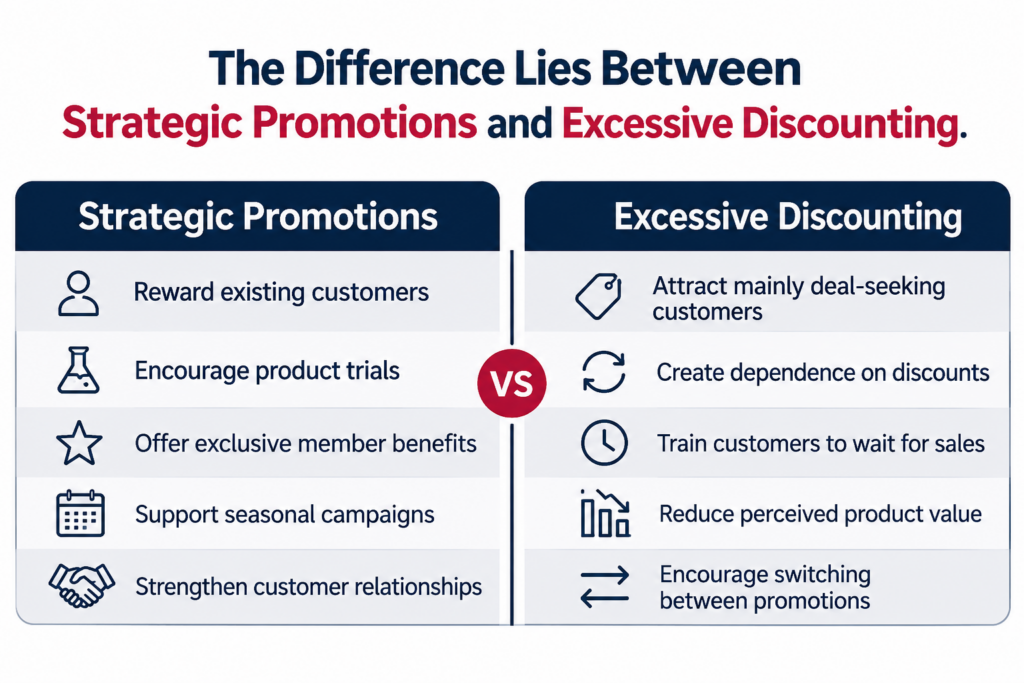
Exclusive discounts can make loyal customers feel valued and appreciated. However, repeatedly offering 30–40% discounts can weaken perceived product value and encourage consumers to postpone purchases until the next promotion.
To this end, marketers need to analyze not just sales but also factors such as repeat purchases, customer retention, full-price sales, and long-term customer value.
How can brands build customer loyalty without constantly offering discounts?
Businesses do not simply need to lower their prices to retain price-sensitive buyers. Instead, it could be better for them if they try showing product value and building rapport with their customers.
Here are five strategies for doing that:
1. Explain the product value: Provide all necessary information about good quality, features and customer support to explain pricing policies.
2. Personalize loyalty rewards: Give discounts and bonuses for loyal customers in accordance with their individual preferences.
3. Improve customer experience: Deliver products faster, provide convenient means of payment and make returns easy.
4. Strengthen loyalty programs: Provide customers with benefits for their repeated purchases.
5. Maintain transparency in pricing: Avoid hidden costs and keep your pricing policy open.
Cut to the chase
Brand loyalty is changing as consumers increasingly compare prices and explore better deals. While discounts can attract customers, long-term loyalty depends on trust, consistent quality, and perceived value. Brands must give consumers compelling reasons to stay rather than relying on price reductions to retain them.
FAQ’s
Brand loyalty reflects a customer’s preference for a particular brand, while price sensitivity measures how strongly price changes influence purchasing decisions. Highly price-sensitive customers may switch brands when competitors offer better deals, even if they previously preferred another brand.
Consumers switch brands to reduce spending, take advantage of discounts, compare product value, and find affordable alternatives. Rising living costs and easier online price comparisons also encourage brand switching.
Discounts can encourage product trials, increase sales, and attract new customers. However, excessive promotions can make consumers dependent on lower prices, reducing their willingness to purchase at regular prices.
At a Glance
- Price influences loyalty: Consumers are increasingly willing to switch brands when they find better value elsewhere.
- Price sensitivity varies: Income, product quality, competition, and purchasing habits influence how consumers respond to price changes.
- Discounts attract new customers: Promotions encourage experimentation but can also create deal-seeking habits.
- Trust builds lasting loyalty: Consistent quality, transparency, and customer satisfaction encourage repeat purchases.
- Value matters more than discounts alone: Brands need to deliver meaningful experiences to retain customers without constantly lowering prices.