

The Future of CTV Advertising: Can Streaming TV Deliver Real ROI?
Television ads can reach millions of households and build strong brand awareness. However, when businesses ask how many viewers visited a website, downloaded an app, or purchased a product because of an advertisement, finding a clear answer can be difficult.
This makes advertising reach alone an insufficient measure of campaign effectiveness. Businesses increasingly need evidence of return on investment (ROI) to understand whether their advertising budgets are delivering meaningful results. Connected TV (CTV) advertising is changing this picture by combining television’s immersive viewing experience with digital targeting, programmatic buying, and more measurable campaign outcomes.
In 2026, advertisers are investing in this shift, although challenges around attribution, incremental conversions, and consistent measurement remain.
Let’s explore why CTV is becoming a performance channel, how it differs from traditional TV advertising, and what this shift means for the future of television marketing.
Why is CTV advertising becoming a performance channel?
Connected TV (CTV) refers to internet-connected televisions and devices used to stream movies, TV shows, and other digital content. These include smart TVs, streaming devices, and gaming consoles. CTV advertising allows brands to reach viewers through these streaming environments while using digital advertising capabilities.
Unlike traditional linear TV advertising, which typically relies on scheduled commercial breaks and broad audience segments, CTV advertising can use audience data, household-level targeting, and campaign analytics to deliver more targeted ads and evaluate their performance.
The statistics regarding investments support this transformation. As stated by the Interactive Advertising Bureau (IAB), U.S. CTV ad expenditure is forecast to rise 15.6% in 2026, revising its September forecast. According to this report, spending on linear TV advertising will decrease by 1.5%. This provides proof that the shift towards streaming, in which the possibility of integrating television storytelling with Internet advertising emerges, is underway.
CTVs are gaining popularity among performance marketers who used to invest exclusively in search, social, and display advertising. As a result, the expectations for the channel these days seem to have grown beyond just reaching the audience.
Advertisers want to learn whether their exposure leads to impressions or conversions.
How is CTV different from traditional TV advertising?
Connected TV (CTV) and linear TV differ fundamentally not so much in how viewers watch content, but in how advertisers develop, run, and assess their advertising campaigns.
While traditional TV marketing has centered on reach, frequency, ratings, and leveraging brand recognition, CTV introduces higher precision in targeting and measures effectiveness, allowing advertisers to see the extent of consumer action.
For instance, a retailer can target specific households using allowed audience filters, display an advertisement for a product while content is streaming, and then analyze whether those households visit the brand’s website or buy the advertised product. Depending on the measurement method and setup, advertisers can also analyze the responses received together with those from comparable groups of households.
The process of buying media becomes even more automated thanks to programmatic CTV advertising. Advertisers can use a demand-side platform (DSP) or an online TV advertising platform to access streaming advertising options, apply targeting criteria, control bids, and adjust campaign delivery.
Yet, CTV differs from search advertising. In general, people watch TV from a distance rather than interact with ads directly. The ability to drive demand is CTV’s main objective.
How does CTV advertising work?
The strategy of CTV performance marketing brings audience planning, ad running, and result measurement together. It includes four steps:
- Audience targeting: Advertisers identify the most appropriate audience by analyzing legally authorized first-party data, checking contextual signals of the target audience, learning demographic details, and reviewing other available segment data.
- Programmatic buying: Platforms used for CTV advertising help advertisers buy broadcast time and display ads to reach earned audiences.
- Cross-device engagement: Viewers respond later by searching for a brand, visiting a site, scanning a QR code, or installing an app on their phone.
- Measurement and optimization: Advertisers analyze campaign success by examining the following factors: delivery, engagement, website activity, conversions, and incremental results achieved by the campaigns. Thanks to such possibilities, CTV has become a very helpful tool for the performance marketer.
It is these abilities that make CTV easier for performance marketers to work with. According to a September 2026 report by EMARKETER, the channel was seeing more and more lower-budget advertisers benefiting from better digital infrastructure for targeting and measurement.
Matt Collins, vice president of product marketing at MNTN, described the opportunity: “The environment is perfectly tailor-made for exactly this to happen.” His comments referred to the combination of precise audience targeting and measurable results that can make CTV attractive to advertisers with more deliberate budgets.
The takeaway for marketers is important. The era in which only large businesses could use TV advertising is coming to an end. With smaller firms now able to test streaming campaigns based on their key business targets, things have changed.
Three examples of CTV advertising’s performance potential
1. Michelin uses Roku to drive brand consideration
In May 2026, Michelin collaborated with Roku on an advertising initiative on Home Screen to enhance brand awareness and increase consideration. According to the case study released by Roku, the campaign achieved an increase in brand awareness by 17% and consideration by 15%. Roku also revealed that 74% of the households that were targeted in this campaign could not have been reached through traditional TV alone.

The campaign illustrates how CTV can combine prominent ad placements with measurable brand outcomes and additional reach. Although brand awareness and purchase consideration do not guarantee conversions, they help advertisers evaluate whether campaigns influence potential customers.
2. AdRoll connects CTV exposure with website activity
In February 2026, AdRoll teamed up with Innovid to enhance the measurement of its CTV offering. The case study found that there was a 23-fold increase in visits to the AdRoll CTV page, along with a 93% increase in the percentage of those visitors.

This example shows how marketers can evaluate outcomes beyond ad delivery. However, increased website traffic does not automatically translate into higher sales or positive ROI. Advertisers must assess attribution and determine whether the campaign generated visits that would not otherwise have occurred.
3. A retailer measures incremental results with Viant
Viant’s published case study describes a retailer that shifted part of its traditional TV strategy to CTV, using advanced targeting and conversion-lift measurement. According to Viant, the campaign delivered a 202% lift in conversions, a 98% increase in website visits, and a 32% reduction in cost per landing-page view.

The case highlights the importance of measuring incremental outcomes rather than relying on impressions or attributed conversions alone. Because the retailer’s identity and full measurement methodology are not disclosed, these vendor-reported results should not be treated as a universal benchmark for CTV campaigns.
How Is CTV advertising measured?
Measurement is the primary consideration in CTV’s transformation from an awareness channel to a performance-based channel. It is essential for advertisers to choose metrics that correspond with campaign goals, rather than only using the same number across all campaigns.
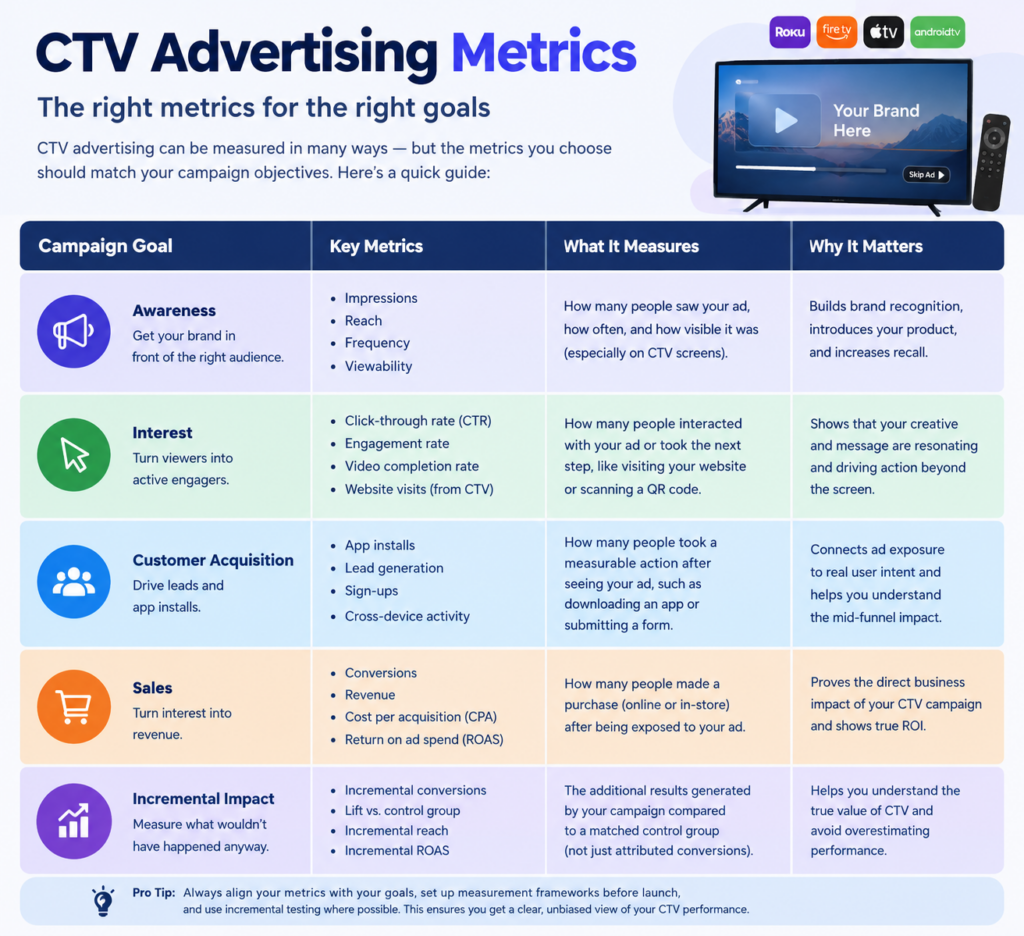
In reality, the appropriate metrics vary depending on whether the campaign’s objective is to raise awareness, drive interest, attract customers, or achieve sales growth.
Measurement remains a significant challenge. In October 2026, EMARKETER reported that CTV leaders were calling for more consistent frameworks across platforms. Nicole Scaglione, vice president of CTV/OTT and OLV at PubMatic, said: “CTV should be … on the hook for business outcomes and attributions.” She also highlighted the inconsistency in current measurement approaches.
The challenge is that platforms use different attribution windows, identity signals, and reporting methods. Moreover, exposure to an ad does not prove that a particular viewer purchased the advertised product as a result.
Advertisers should establish consistent measurement definitions before launching campaigns and conduct incrementality tests whenever possible. They should also evaluate CTV alongside search, social, and retail media to understand its contribution and avoid double-counting conversions.
What are the benefits of CTV advertising for performance marketers?
CTV is characterized by a number of possible advantages:
- More precise targeting: Reach relevant audience segments instead of relying solely on broad television demographics.
- Measurable consumer actions: Connect eligible ad exposure with website visits, app activity, leads, and purchases.
- Incremental reach: Reach streaming households that may be difficult to reach through linear TV alone.
- Flexible media buying: Use programmatic CTV advertising to adjust targeting, bids, and campaign delivery.
- Brand building and conversion support: Use engaging television ads to generate demand and digital channels to capture it.
These advantages depend on campaign planning, advertising inventory, audience data, advertisement effectiveness, and measurement.
What happens to TV advertising next?
The future of CTV advertising will depend on three key developments: better measurement, more accessible media buying, and deeper integration with other digital channels.
First, advertisers will increasingly expect CTV campaigns to demonstrate a measurable business impact. Improved cross-device measurement, privacy-conscious data collaboration, and more consistent reporting could help marketers better understand campaign effectiveness.
Second, AI and automation could make campaign planning, audience targeting, and optimization more accessible. However, technology cannot compensate for weak creative or poorly defined objectives.
Third, CTV will become more integrated with the wider media mix. A consumer might see a streaming ad, research the product on a smartphone, and later purchase it through a retailer’s website. Understanding these interactions will help marketers assess how different channels contribute to the customer journey without automatically attributing every sale to one channel.
This does not mean linear television will disappear. Broad-reach campaigns, live events, and popular programming will continue to play a role. Instead, advertisers will need to balance linear TV and CTV according to their audiences, budgets, and campaign objectives.
Cut to the chase
Advertising via CTV is evolving away from brand awareness, providing marketers with new opportunities to reach their target audiences and analyze the performance of their ad campaigns. It will have high usability given the presence of solid attribution, incremental results, and the opportunity to convert audience engagement into tangible business results.
FAQ’s
CTV advertising delivers video ads through internet-connected TVs and streaming devices, combining television’s reach with digital targeting and measurement.
Traditional TV focuses mainly on reach and frequency, while CTV offers audience targeting, programmatic buying, and performance tracking.
Marketers measure CTV advertising using impressions, video completion rates, website visits, conversions, cost per acquisition (CPA), incremental lift, and return on ad spend (ROAS).
At a Glance
- CTV is evolving: Connected TV advertising is moving beyond brand awareness toward measurable business outcomes.
- Targeting is more precise: CTV helps advertisers reach relevant audiences through digital targeting capabilities.
- Performance can be measured: Metrics such as conversions, CPA, and ROAS help evaluate campaign effectiveness.
- Incrementality matters: Advertisers should determine whether CTV generates additional results rather than relying only on attributed conversions.
- The future is integrated: Combining CTV with search, social media, and other digital channels can help marketers understand the customer journey more effectively.