

Rethinking Marketing Performance Through Neuroscience
Marketing teams are expected to respond quickly to changing customer behavior, shifting priorities, and growing performance demands. Yet constant activity can come at a cost. When people have little time to process information, explore ideas, or consider different approaches, the quality of their decisions and creative work can suffer.
Amy Brann has spent more than two decades exploring how neuroscience can help organizations create the conditions for people to think clearly and perform sustainably. She founded Synaptic Potential in 2003 and is the author of Make Your Brain Work, Neuroscience for Coaches, and Engaged. She is also an Associate of the Møller Institute at the University of Cambridge and has contributed to leadership programs and university courses.
Through her work as a psychology and neuroscience speaker, Brann translates research about the brain into practical guidance for leaders and teams.
In this exclusive interview with Ad Pulse, she discusses how workplace conditions influence marketing performance, why uncertainty can activate the brain’s threat response, and how leaders can help teams develop the cognitive flexibility to navigate change.
How high-performing organizations create the conditions for better work
- Workplace conditions and performance: How competing demands, constant change, and unclear priorities affect marketers’ ability to think and perform.
- The neuroscience of uncertainty: Why change can activate the brain’s threat response and influence how people approach decisions.
- Creating space for better thinking: How organizations can build working environments that support focus, creativity, and sound judgment.
- Cognitive flexibility: Why the ability to adapt thinking and respond to unfamiliar situations matters in changing workplaces.
- Sustainable performance: How leaders can apply neuroscience to help teams work effectively without relying on constant pressure.
Marketing performance is about so much more than creative ability or setting ambitious targets. The constant churn of campaigns, the competing demands, and the lack of clear priorities can leave teams with very little time to think about what they’re doing and do it properly.

Beyond setting ambitious goals, how do high-performing organizations create the conditions that allow people to perform at their best?
Amy Brann: “High-performing organizations design the conditions that make ambitious goals achievable. They work with the brain rather than against it.
They understand that performance depends on individual capability and the systems that release that capacity. Such organizations reduce cognitive overload, streamline workflows, and create environments where focus and clear thinking can happen.”
“Many organizations unintentionally block performance through constant interruptions, unclear priorities, frequent reprioritization, and low-value activities. High-performing organizations pay attention to three critical elements: mind frames, behaviors, and physical environments. They actively shape how people filter information, think, and act. They are explicit about the observable actions they want to see and design the right context around them.”
“They build systems rather than relying on motivation alone. This is where the Whole Brain Potential framework comes in. They begin by reimagining what is possible, redesign how they will achieve it, and reinforce the behaviors needed to succeed.”
“This is supported by clarity and psychological safety. When people know what is expected and feel safe contributing, the brain can move away from an unhelpful threat response and unlock creativity, collaboration, and better decision-making.”
“High-performing organizations do more than recruit talented people. They create the conditions in which that talent can be released and thrive.”
Why uncertainty affects marketing decisions
Marketing doesn’t sit still.
A campaign can be moved, the budget slashed, or a new channel introduced with absolutely no warning. If expectations are constantly in flux, the team can end up more focused on avoiding mistakes than on actually testing anything or engaging with the customer in any meaningful way.
What happens neurologically when people encounter sudden change or uncertainty, and how can leaders reduce the resulting threat response?
Amy: “The brain is fundamentally a prediction machine. It constantly tries to anticipate what will happen next to keep us safe and operate efficiently.”
“When change or uncertainty disrupts that prediction system, it can trigger a threat response. Neurologically, uncertainty increases activity in regions associated with threat detection and reduces activity in the prefrontal cortex, which supports rational thinking, decision-making, and creativity.”
“The brain becomes less effective and more reactive. During periods of change, we often see increased anxiety, resistance, and short-term thinking. This does not mean people lack capability. Their brains are trying to protect them.”
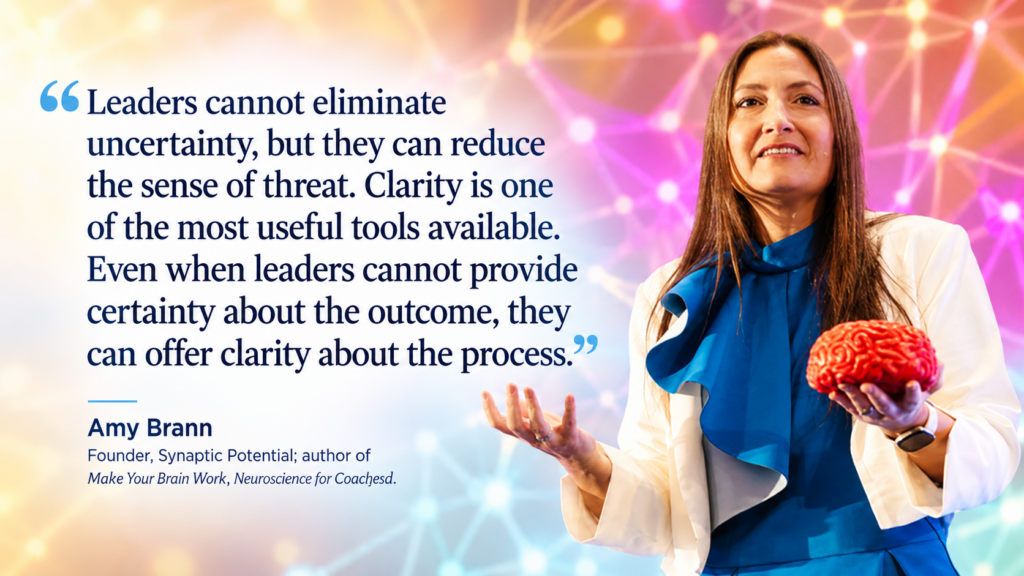
“Leaders cannot eliminate uncertainty, but they can reduce the sense of threat. Clarity is one of the most useful tools available. Even when leaders cannot provide certainty about the outcome, they can offer clarity about the process. Explaining how decisions will be made, what the priorities are, and what good looks like can provide enough security to calm the threat response.”
“Framing also matters. The brain responds differently depending on whether change is presented as a threat or an opportunity, as many organizations are seeing with AI. A leader’s role is to help shape the brain’s response to change, moving people from fear and reactivity towards curiosity and adaptability.”
Building cognitive flexibility in marketing teams
Marketers regularly face new tools, changing audience expectations, and campaigns that do not perform as planned. The ability to reconsider an approach without becoming defensive can help teams learn from setbacks rather than repeat familiar tactics.
How can people develop the cognitive flexibility needed to respond constructively to disruption?
Amy: “Handling disruption effectively requires cognitive flexibility alongside resilience. This is the brain’s ability to adapt, reframe, and respond constructively to change.
The first step is reframing. If disruption is seen as a threat, we contract. If it is seen as an opportunity, we expand. Changing the frame can put people in a stronger position to respond.”
“The second step is exposure. The brain adapts through experience. When we repeatedly engage with a new challenge, we strengthen neural pathways and build greater stability, freeing up mental capacity to respond positively to change.”
Amy Brann, Founder, Synaptic Potential, author of Make Your Brain Work, Neuroscience for Coaches, and Engaged
“The third step is designing environments that support adaptability. People need spaces where experimentation is safe, failure is reframed as learning, and curiosity is encouraged. Leaders are instrumental in creating those conditions.”
“We use our Reimagine, Redesign, Reinforce framework to help individuals and organizations embed these patterns until adaptability becomes the norm. The ability to handle disruption is now a core skill.”
Turning neuroscience into everyday marketing practice
Understanding how the brain responds to pressure is only useful if it leads to a change in how people work. For marketing leaders, that could mean rethinking how teams handle distractions, respond to an underperforming campaign, and create space for new ideas without simply adding more to an already full plate.
What practical shift do you want audiences to make after hearing you speak?
Amy: “Above all, I want people to leave with a sense of their potential and a clear way to act on it. Most people I work with are incredibly capable. They are smart, but they operate within systems that make performance harder than it needs to be.”
“When they understand how their brain works, something shifts. They realize that working differently can be more effective than simply trying harder.”
“I want audiences to leave with three things. First, clarity. I want them to have a simple, science-backed understanding of what drives focus, performance, and wellbeing, cutting through conflicting advice.”
“Second, ownership. I want them to have the confidence to ask, “What will help my brain work best right now?” They can then make intentional choices about their attention, behavior, and environment.”
“Third, action. I want them to have practical tools they can apply immediately to reduce distractions, improve decision-making, or create better team dynamics.”
“My goal is to move people away from reactive, overloaded ways of working and towards more intentional, brain-aligned performance. When people understand how their brains work, they perform better and feel better. That is where sustainable impact happens.”
What Amy Brann’s insights mean for marketing leaders
Marketing teams are often judged by campaign results, creative output, and how quickly they respond to changing business needs.
But Brann’s insights point to an easy-to-overlook factor: the conditions under which people are expected to deliver those results. Constant reprioritization, competing demands, and a lack of clarity can make it harder for even experienced marketers to think creatively and make sound decisions.
This is, of course, very much the case as AI changes the way marketing teams research their audiences, create content, and optimize their campaigns. The introduction of new tools brings its own set of uncertainties (what the new roles might be, what the value of existing skills might be, etc.), and just asking people to adapt more quickly doesn’t really address any of that.
Brann’s focus on clarity, psychological safety, and cognitive flexibility is very useful.
Marketing leaders need to give their teams a clear sense of where they are going while also allowing them to question the status quo, try new things, and learn from experiments that don’t work.
When people understand what is expected of them and feel able to ask questions and contribute, they are in a much better position to respond in a considered way rather than just react to every new thing that comes their way.
The lesson is that better marketing performance cannot be driven by targets alone. Leaders also need to examine how work is organized, how change is communicated, and whether their teams have the conditions to do their best thinking.
In a field where creativity and adaptability matter, the working environment is part of the performance equation.