How Duolingo Became a Gen Z Product First and a Learning App Second
There is a useful analogy about white chocolate. It is marketed as chocolate, known as chocolate. But anyone who has eaten both knows white chocolate has removed every component that makes chocolate what it is — the cocoa solids, the bitterness, the thing that justifies the name. What remains is sugar and milk wrapped together.
Thank you for reading this post, don't forget to subscribe!Duolingo is white chocolate.
It is a language learning app on your phone. But strip it down, and what Duolingo has actually built is an engagement machine. A streak-defending, badge-collecting, notification-spamming piece of software engineered for one goal.
It is getting you to open it and making you come back tomorrow. Whether you learn anything is, at best, a secondary concern.
Let’s dive deep to understand what makes Duolingo popular despite AI penetration, relentless gamification, and subscription plans.
The generation that made Duolingo a giant
Duolingo is becoming a new-gen product, for Gen Z and Gen Alpha essentially.
Roughly 60 percent of Duolingo’s daily active users are aged 16 to 34, with the 18-24 cohort making up the largest segment on the platform. In the United States specifically, approximately 60% of learners are under 30.
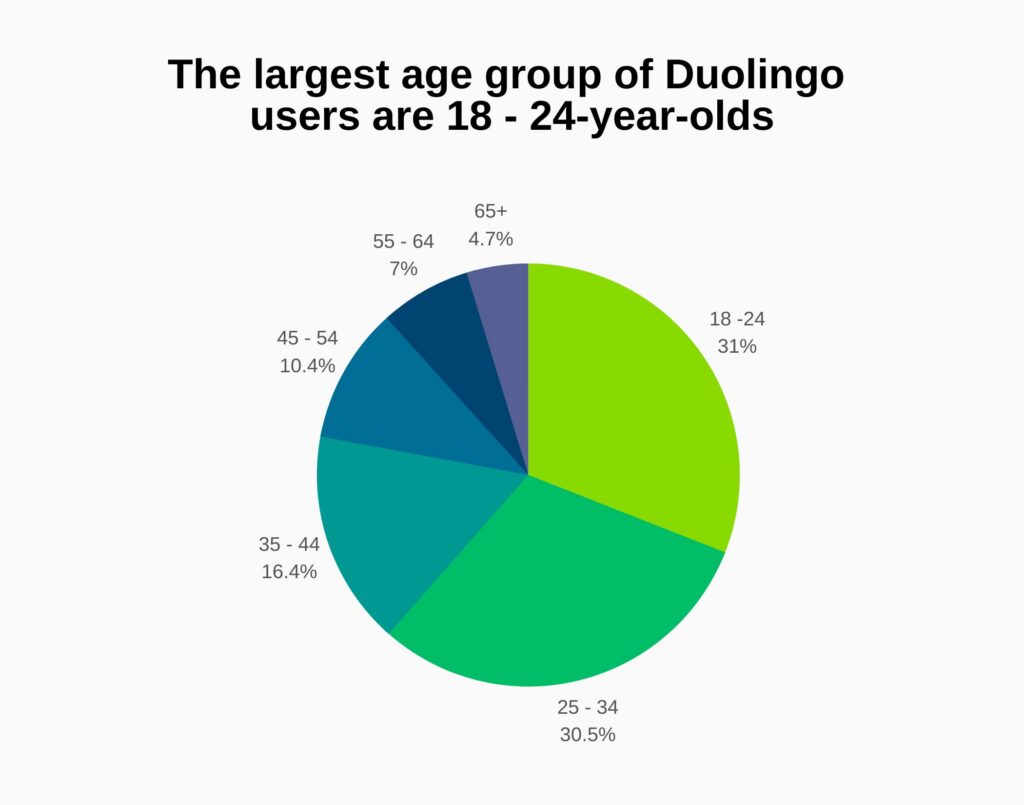
Duolingo isn’t a language app that happens to be popular with young people. It is, structurally, a Gen Z and Gen Alpha product. Every design decision it makes begins from that demographic reality.
This matters because Gen Z, or Zoomers, has been evolving their screen learning behavior. Researchers at Frontiers in Education talked about Gen Z preferences for “dynamic and immersive learning experiences.”
Traditional methods, the research notes, “often fail to capture their attention and foster meaningful engagement.” For Gen Z, the screen is the format. The action on the screen is communication.
And then there is the attention span problem. Gen Z’s average attention span is around 8 seconds, equal to Gen Alpha’s and roughly 4 seconds shorter than millennials’. Teen users now toggle between apps every 44 seconds.
These are design constraints. Apps are competing with social media, AI chatbots, and gaming apps for Gen Z’s attention. Duolingo understood this most before.
Gen Z, AI, and why the app fits the generation
There is another layer that explains Duolingo’s hold on its core demographic: Gen Z is the most AI-fluent generation, followed by Gen Alpha. A 2025 Deloitte survey found that 76 percent of Gen Zers have used standalone generative AI tools. It has the highest adoption rate of any generation.
Another SurveyMonkey study found that 61 percent of Gen Z respondents use AI tools specifically to support learning, making education the top use case for the cohort.
This is the audience Duolingo is building for.
Logo changes, app icons, and the attention economy war
Duolingo knows exactly who it is competing with. It is not competing with Babbel or Rosetta Stone. It is competing with YouTube, Netflix, Twitch, TikTok, and every other claim on a young person’s screen time at 9 pm.
This is what explains marketing. It explains Zaria Parvez, Duolingo’s senior global social media manager, building the brand’s TikTok presence from 50,000 followers to 16 million in four years using what she openly calls an “unhinged” approach.
It’s what explains the Dead Duo campaign in February 2025. The app’s owl mascot was killed off via Cybertruck, generated 1.7 billion social impressions in two weeks, and was declared the biggest brand moment in Duolingo’s history by Creative Director James Kuczynski.
And it is exactly what explains the app icon strategy. Duolingo changes its icon periodically for users — a sick owl, a shriveled owl, a melting owl, a dead owl. It internally tracks the user’s acquisition spike that follows each change.
The icon is not branding. It is a stimulus. It creates curiosity, generates social media posts, and pulls dormant users back into the app.
This is Duolingo competing on the same psychological terrain as an infinite scroll. Constant screen exposure, constant visual surprise, constant presence. For Gen Z, it works. Being visible is not optional in a world where 5,000 pieces of content hit a user daily.
Where Duolingo starts failing when the humans are left
This is where the story gets harder to ignore. In late 2023 and early 2024, Duolingo let go of over 100 contract writers, translators, and curriculum designers. They were the people who had built the app’s playful tone, pedagogical structure, and cultural nuance. In January 2024, the company confirmed it had cut 10 percent of its contractor workforce, citing AI-driven content creation as the replacement.
Then in April 2025, CEO Luis von Ahn made it official in a company-wide memo. Duolingo was going “AI-first.” The company would “gradually stop using contractors to do work that AI can handle.” New hires would only be approved if a team could demonstrate the work couldn’t be automated.
And in a line that would define the backlash on Duolingo for months: “We’d rather move with urgency and take occasional small hits on quality than move slowly and miss the moment.”
Duolingo received backlash from users
The problem with building a product specifically for Gen Z’s learning psychology is that it creates significant friction for everyone else.
Using generative AI, Duolingo launched 148 new courses in under a year. The speed was extraordinary. The quality was not. Users began reporting that content felt repetitive, robotic, and stripped of the personality that had made early Duolingo distinctive.
Users noticed the quality hits. Reports of repetitive, robotic content began to accumulate across forums and review threads. Language teachers flagged accuracy issues. The cultural nuance that distinguishes fluency from rote memorization.
The damage showed up in the numbers. DAU growth, which had run at 60% year-over-year for consecutive quarters, dropped to 40% in Q2 2025.
On the earnings call, von Ahn acknowledged the cause plainly: “The reason we came towards the lower end was that I said some stuff about AI. And because of that, we got, particularly on our social media, some backlash on it.”
Incessant ads restrict freedom on the app
The monetization mechanics compounded the problem. Frequent ads that removed the skip button began pushing free users toward uninstalls.
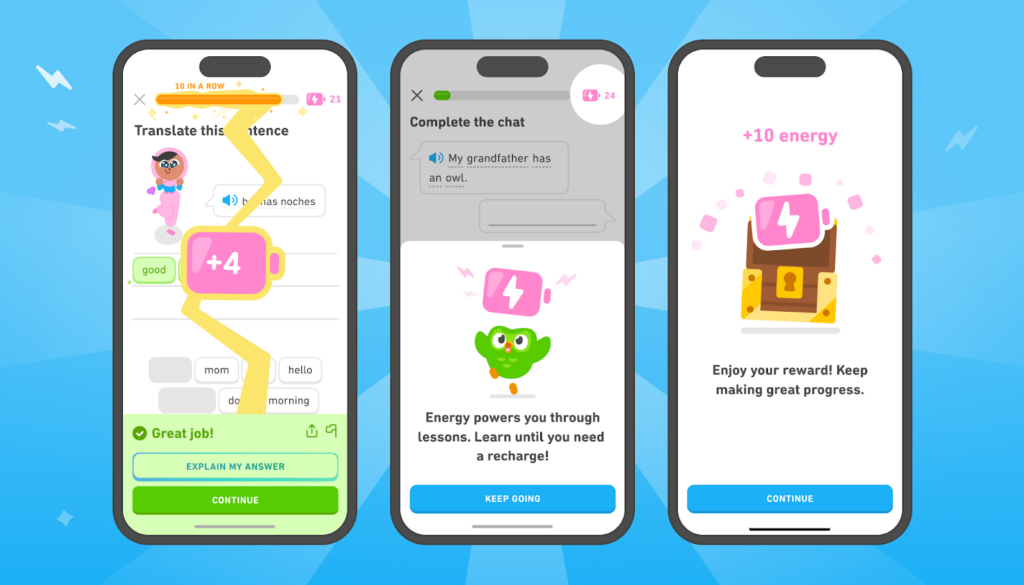
The July 2025 rollout of the Energy system.
It replaced the old Hearts model and was depleted with every exercise. Users perceived this as a further restriction, penalizing skilled learners and longtime subscribers rather than just casual ones.
For a serious adult learner seeking B2-level proficiency in Japanese or Arabic, these are reasons to leave.
The imbalance that Duolingo must correct
Duolingo’s bet on Gen Z and Gen Alpha makes strategic sense. Gen Z comprises 26 percent of the world’s population, with spending power expected to reach $12 trillion by 2030. Designing for their attention span, AI comfort, and screen-first learning preferences is a master strategy.
But a language platform has a harder accountability requirement than a content platform. Netflix doesn’t fail you if you get bored and leave. Duolingo fails you if you spend six months with it and still can’t order food in Paris. The core promise is demonstrable skill acquisition. That learning promise cannot be fulfilled by AI-generated content alone, or by a gamification layer that rewards a streak of survival rather than communicative competence.
Von Ahn himself gave it away in an earlier, more candid moment: users “were just addicted to their streak. And they weren’t actually learning anything.” That was not a critique of AI. It was a critique of the product’s own design philosophy.
Duolingo works for Gen Z because Gen Z’s expectations of what learning looks like are compatible with what Duolingo actually delivers. The white chocolate is everywhere. The question is whether Duolingo ever plans to add the cocoa back or come up with a different version.
Cut to the chase
The problem is that Duolingo doesn’t compete with language schools. It competes with TikTok. And every decision it makes increasingly reflects that reality.
The question isn’t whether Duolingo can keep people coming back tomorrow.
It’s whether those people will eventually be able to speak the language they opened the app to learn.