Human Branding is Growing in 2026, Even as Marketers Bet Big on AI
The market is a place to find a good contradiction, and 2026 is serving us one on a silver platter. On the one hand, brands and agencies are sprinting toward AI integration by automating workflows, accelerating creative production, and optimizing everything that can be. On the other hand, human branding is quietly reclaiming center stage.
Since late 2025, and increasingly into early 2026, brands that feel handcrafted, imperfect, and unmistakably human are getting more reception than the polished, algorithmically perfected outputs that AI excels at. Consumers are voting with their attention.
Hereinafter, it becomes significant to ask what is driving consumers towards human branding over AI. We will dive in to find the answers.
Art, craft, and human branding back in the spotlight since January
The opening quarter of 2026 has already set the tone. Hermès’ Craft collection, Heineken’s return of The Most Interesting Man in the World, and a wave of brand storytelling rooted in artistry and cultural memory signal that human-led creativity is still holding the power.

Hermès’ hand-illustrated website experience is a standout example. It’s slow. It’s deliberate. It feels touched by a person. And that’s precisely why it works. The illustrations are imperfect yet give a human touch.
That’s the kind of reward AI-polished ads struggle to deliver. AI makes things flawless. Humans make them memorable.
Why hyper-polished AI ads are falling flat
AI-made ads didn’t exactly win hearts at the Super Bowl last year—and 2026 didn’t change the verdict. According to System1’s Super Bowl ad rankings, audiences consistently gravitated toward ads that felt heartfelt and human.
Here’s the hard data:
- In 2026, 18% of Big Game ads featured explicit AI messaging
- Those ads averaged 2.1 Stars
- Overall Super Bowl ads averaged 2.7 Stars, down from 3.0 Stars in 2025
Meanwhile, a record number of 5-Star ads came from returning advertisers who leaned into emotional storytelling, not perfect spectacle.
AI presence alone doesn’t impress people. If anything, it creates skepticism.
Subscribe to our bi-weekly newsletter
Get the latest trends, insights, and strategies delivered straight to your inbox.
The plot twist: people can’t even spot AI content
Now here’s where it gets interesting.
According to a survey conducted by NP Digital, most people don’t actually know when they’re looking at AI-generated content. Neil Patel specifically called out social platforms, but the implications stretch far wider.
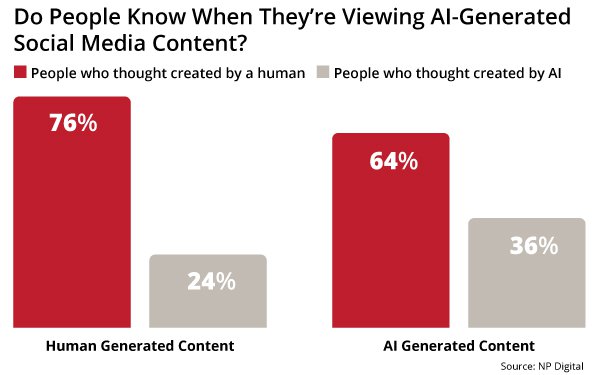
In a study involving 100 participants:
- 76% correctly identified human-made content
- 24% thought human-made content was AI
- 64% mistook AI-generated content for human-made work
If people can’t tell what AI is, and still feel emotionally disconnected, then the issue isn’t detected. It resonates. AI can imitate tone, but it can’t replicate lived experience. Audiences sense that gap, even if they can’t articulate it.
Three consumer shifts shaping 2026 branding
Two consecutive Super Bowls and a year of consumer data have made one thing painfully clear: the rules of engagement are changing. Three behavioral patterns from 2025 are now solidifying into 2026 expectations.
1. Consumers want freshness, not frequency
Repetition is the fastest way to irrelevance.
According to Smartly, audiences are actively rejecting ads that feel recycled or stalkerish. The numbers don’t lie:
84% say rotating or updated ads feel more relevant
Nearly 40% feel uncomfortable when the same ad follows them after they’ve ignored it
AI makes repetition easy. Too easy. That’s the trap.
Automation without variation doesn’t feel smart—it feels lazy.
2. Trust requires human involvement
Consumers are open to AI—but they don’t want machines to work alone.
Research shows:
48% trust ads co-created by humans with AI support
Only 13% trust ads made entirely by AI
That’s not subtle feedback. That’s a line in the sand.
AI is welcome as a tool, not as the author.
3. UGC still beats brand-speak—especially in B2B
Despite all the AI hype, user-generated content remains one of the most trusted formats in marketing.
A Photo Shelter study shows marketers worldwide still lean heavily on UGC to drive engagement. And in B2B, the dependence on human validation is even stronger.
According to the 2024 Demand Gen Survey Report:
55% of B2B buyers say UGC directly influences their decisions
Case studies, testimonials, peer voices—these are trust accelerators. AI-generated endorsements? Not so much.
AI needs humans more than humans need AI
This isn’t an anti-AI argument. Brands would be foolish to ignore them. AI is already embedded in strategy, production, targeting, and personalization.
But 2026 is exposing a hard truth: AI doesn’t replace human branding; it amplifies it when used correctly.
The brands winning right now aren’t choosing sides. They’re choosing balance.
Human insight sets the direction. AI speeds up the execution. Creativity stays rooted in lived experience, not prompts.
Human branding isn’t making a comeback. It never left.
What’s changing is the tolerance level. Audiences are done being impressed by technical capability alone. They want meaning, intention, and cultural awareness—things that don’t come from datasets.
Cut to the chase
In 2026, the brands that stand out won’t be the ones shouting about AI. They’ll be the ones quietly using it behind the scenes, while putting humans back at the center of the story.