
Automation Without Intent Is a Brand Failure in the Era of AI
In the era of AI, AI slop became the word of the year in 2025. Digital platforms, including Meta and X, leaned heavily into promoting AI-generated content alongside bots. But brand trust has shifted the discussion since the start of the new year.
What was once in the green zone has moved to yellow—and now dangerously close to red. Consumers are showing less interest, reporting ad fatigue, and describing mental exhaustion after prolonged exposure to what they label brain-rot content.
Attention is the new currency, and brands are becoming poorer of it by the day. Less interaction on digital platforms, declining trust, fewer clicks, and weakening performance have created an ouroboros effect, where brands chase attention with automation, only to lose more of it in the process.
An eMarketer study highlights how AI is reshaping consumer perceptions of brand trust. The shift is rapid, and the warning signs are clear. Brands that fail to understand this moment risk losing relevance altogether.
Loud signs telling the tales in the AI age
Trust has reached the lowest level in the era of AI. Due to significant hurdles such as the Iran war, the Recession in 2008, and the COVID pandemic, the decline in trust is not subtle. The impact affects brands and their marketing practices, too. In addition to those hurdles, AI becomes another tool that raises the brows of consumers on brand authenticity.
Blake Droesch, Senior Analyst, EMarketer, said in a session on brand trust in the AI space.
“Trust has been declining since 2000, and it has reached its lowest level today. U.S. audiences are very wary of tech platforms—including media, marketing, and brands.”
However, one cannot deny the growth of AI in marketing.
AI has entered this fragile environment not as the cause of mistrust, but as a force multiplier.
“AI-generated content is growing and eroding the trust the public usually holds for content,” Blake notes.
From the synthetic audience to the rise of AIO, automation has become real, and it will only scale further in the coming years—but scale without intent is starting to show cracks.
Brand safety on lines
One of the earliest signs came in 2022 with the rollout of Advantage+ in Meta advertising. Content production and ad deployment increased dramatically, but so did the autonomy brands hand over to platforms.
Jeremy Goldman, Senior Director of Content, EMarketer underscores the risk:
“Consumers should feel trust if they are going to buy or interact with brands. Brand safety is one big issue.”
AI doesn’t mask brand behavior—it exposes it. Over-polished, perfectly optimized messaging can backfire if it doesn’t reflect reality.
“Brands are not able to hide their shadiness with AI,” Jeremy adds. “They’re overly polished and perfect in public image—and that backfires when it doesn’t match reality.”
In the process, brand safety began slipping away—slowly, almost invisibly. As Ad Pulse has often framed it, this is the logic of the scam economy: scale first, accountability later.
Deploying AI content at fast speed
Around the same time, the emergence of ChatGPT triggered a sudden spike in English-language content creation. Quantity exploded. Quality didn’t keep pace.
Suzy Davidkhanian, VP of Content, EMarketer, explains why this matters:
“Brands don’t get automatically trusted; they need to earn it. With AI usage rising, there’s tension around automatic trust—context, data safety, authenticity, value, and culture all matter.”
The issue isn’t AI itself. It’s intent.
“It’s not that AI is changing trust,” Suzy says. “It’s how brands use intent to deploy it.”
The result was a flood of content that looked polished but did not resonate with culture or moment. For consumers, especially younger ones, the difference was easy to sense.
The new generation can sense AI
Gen Alpha’s rapid entry into digital spaces has only intensified this gap. Unlike previous generations, they can identify AI-generated slops with remarkable accuracy.
What might pass as “efficient” or “optimized” content to brands often reads as fake, lazy, or untrustworthy to them. Their tolerance for synthetic messaging is far lower than marketers assume.
Inefficient AI agents are making it worse
At the same time, AI agents and automated systems remain weak at one of the most critical moments in the consumer journey. Discovery. Search, comparison, and shopping decisions still rely heavily on human context, nuance, and trust cues, where AI currently underperforms. Automation promises convenience, but it struggles to replicate judgment.
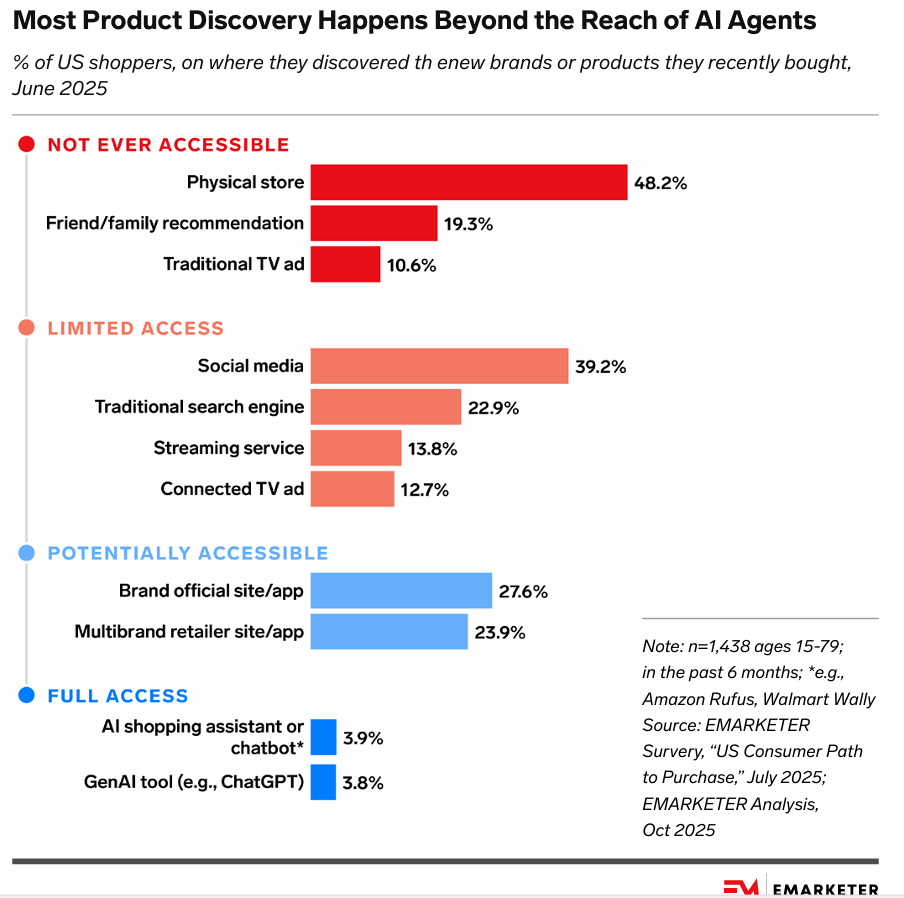
As a result, brands are finding it harder to form bonds with consumers on digital platforms alone.
What becomes the brands’ point of return in era of AI
Blake points to a growing counter-movement:
“Brands are relying more on in-store and physical experiences. Direct contact matters.”
Run clubs, local parenting groups, and community-led brand initiatives are resurging. Dick’s Sporting Goods’ experiential retail and Netflix House signal a renewed focus on presence, not just reach.
A Harris Poll found that 8 in 10 consumers find events or in-store experiences more memorable than digital interactions.
Brands that have earned trust
Some brands have navigated this moment with clarity.
Suzy points to Dove as a long-term example:
“Inclusivity and bringing women together are something Dove has built through trust and reputation.”
Trust doesn’t vanish overnight, nor is it earned instantly.
“It takes time to erode trust,” Suzy notes. “You can earn it faster than you lose it—unless a brand does something horrific.”
Aerie’s anti-AI messaging and REI’s decision to close stores on Black Friday are further examples of brands aligning action with values.
“You don’t need to be perfect, but you must be transparent.”
Suzy Davidkhanian
Using AI without losing trust
AI is not a villain.
“AI is a tool,” Suzy explains. “It can amplify your message—or amplify chaos. Brand value, perception, and image must be under your control before unleashing it.”
Blake reinforces the point:
“Whatever channel or tool you use, if the brand positioning isn’t effective, it won’t matter to consumers.”
Connection has shifted away from brand-owned channels and toward creators—individuals who still carry perceived authenticity and relatability.
Creators have become essential not because they scale better, but because they feel human in an increasingly automated ecosystem.
Cut to the chase
Brands should not place the onus of trust and reputation on AI or automation. In the era of AI, reinforcing brand values and deploying AI tools must be rooted in a brand’s foundation and ethos.