
How Ethical Marketing Draws the Line Between Influence and Manipulation
We live in an age of attention economy, where brands no longer shout—they whisper; they hint, they nudge. They use subconscious marketing, ethical marketing, and brain-based strategies to keep messages rooted in mind without the customer consciously realizing it. This subtle power is like a double-edged sword — when used ethically, it helps, informs, and builds trust; when misused, it becomes manipulation.
The dilemma is simple yet critical: can brands utilize brain-related techniques while respecting consumer autonomy and fostering loyalty? Or will they fall into a digital mind game that confuses, exploits, and ultimately destroys trust?
Let’s look at the line between influence and manipulation, some of the causes that have led to the rise of neuromarketing, and suggestions for establishing guardrails that protect ethical marketing and persuasion.
Influence ≠ manipulation—The ethical marketing separation
Influence is an act of persuasion grounded in open communication and respectful of the person’s autonomy in decision-making.
Manipulation is the act of concealing or disguising the end goal. An unethical marketing strategy would involve nudging users towards an outcome they would not have arrived at if they were able to fully leverage their own decision-making capacities.
What’s the relevance of this today? Neuromarketing methodologies are on the rise.
We see corporations from around the globe rapidly investing in EEG, eye-tracking, and biometric measurement to evaluate advertisements and experiences. That means more brands can craft messages, targeted not just at what consumers say they want, but also at how their brains are actually processing information.
Why ethical marketing matters in the age of neuromarketing
Subconscious marketing is the use of nonconscious cues, such as sights, sounds, movement, scent, microcopy, and layout, to elicit perception and decision-making.
Imagine a checkout page that visually foregrounds a default plan, or a product framed in a way that captures feelings of exclusivity, or an ambient scent in a retail store that makes the wait feel shorter. That’s why ethical marketing demands responsibility — ensuring that subconscious nudges support the customer’s best interest, not exploit it.
These methods are effective because decision-making does occur below the level of conscious awareness. Neurological evidence suggests that emotional and attentional circuits often drive purchase behavior.
Marketers’ brain-based strategies and how they function
These are subtle but powerful ways brands speak directly to the subconscious mind — without a word.
- Priming: Subtle cues (like colors, smells, or music) can make related ideas more present in a consumer’s mental agenda.
- Anchoring: Marketers may initially display a higher reference price, making the subsequent price appear more attractive as a bargain.
- Default options & choice architecture: People tend to stick with the default. When a better option is offered as the default (e.g., energy-saving mode), consumers are nudged towards a better outcome.
- Emotional framing: Advertisements that activate one of the core emotions (joy, fear of missing out, or a sense of belonging) are easier to remember because emotion helps enhance encoding in memory.
- Neuromarketing Tools: This includes EEG, eye-tracking, and biometric sensors, which enable brands to measure what really captures attention or generates emotion, much more accurately than traditional surveys.
The three red lines—when ethical marketing becomes manipulation
The following points aren’t just hypothetical concerns. Public confidence in institutions and online information has been weakening the authenticity. This increases the danger for companies that use deceptive strategies rather than open communication.
- Concealment of intent: If customers can’t recognize that you’re influencing them, or if you hide your intent through tactics like fake reviews or undisclosed sponsorships, you’re manipulating them.
- Exploitation: If you’re targeting groups precisely because of their known cognitive vulnerabilities (e.g., aggressively upselling products to people experiencing financial hardship), then you’ve crossed a moral boundary.
- Data misuse and false profiling: If you build profiles using harvested data or apply undisclosed psychometrics without informing customers about the information behind their persuasion profiles, you’re engaging in manipulation by stealth.
Techniques for ethical persuasion—making influencing right
These practices protect choice and build trust over time as a brand—trust customers trade in and assign measurable value to as an asset.
- Transparency: Clearly disclose native advertising, paid placements, and sponsored content. Indicate when a design has been created to persuade.
- Consent-first data practices: Collect only the data you need, explain how you’ll use it for personalization, and give people an easy way to opt out.
- Beneficial defaults: If you employ defaults or nudges, always design them to benefit the satisfied customer, rather than driving personal profit. For example, opt-out privacy-protecting settings as the default
- Testing for harm: Before rolling out behaviorally targeted campaigns, audit the potential for harm or disproportionate effects on target vulnerable people.
- Explainability: If using AI/neuromarketing tools to enable personalization, be able to explain the” why” in plain language to the reasonable general public.
Building brand trust through ethical marketing
Neuromarketing does not need to encroach on privacy to function. Instead, brands can employ non-intrusive methodologies, such as including EEG, eye-tracking, and opt-in research panels, with a commitment to anonymizing data and storing it only when necessary. Privacy-by-design — using minimal data, clear consent, and transparency — creates ethical marketing and persuasion.
Trust is the real return on investment. Covert manipulation may encourage clicks, but it will ruin loyalty. Ethical marketing fosters long-term customer relationships; manipulation, on the other hand, encourages litigation and distrust.
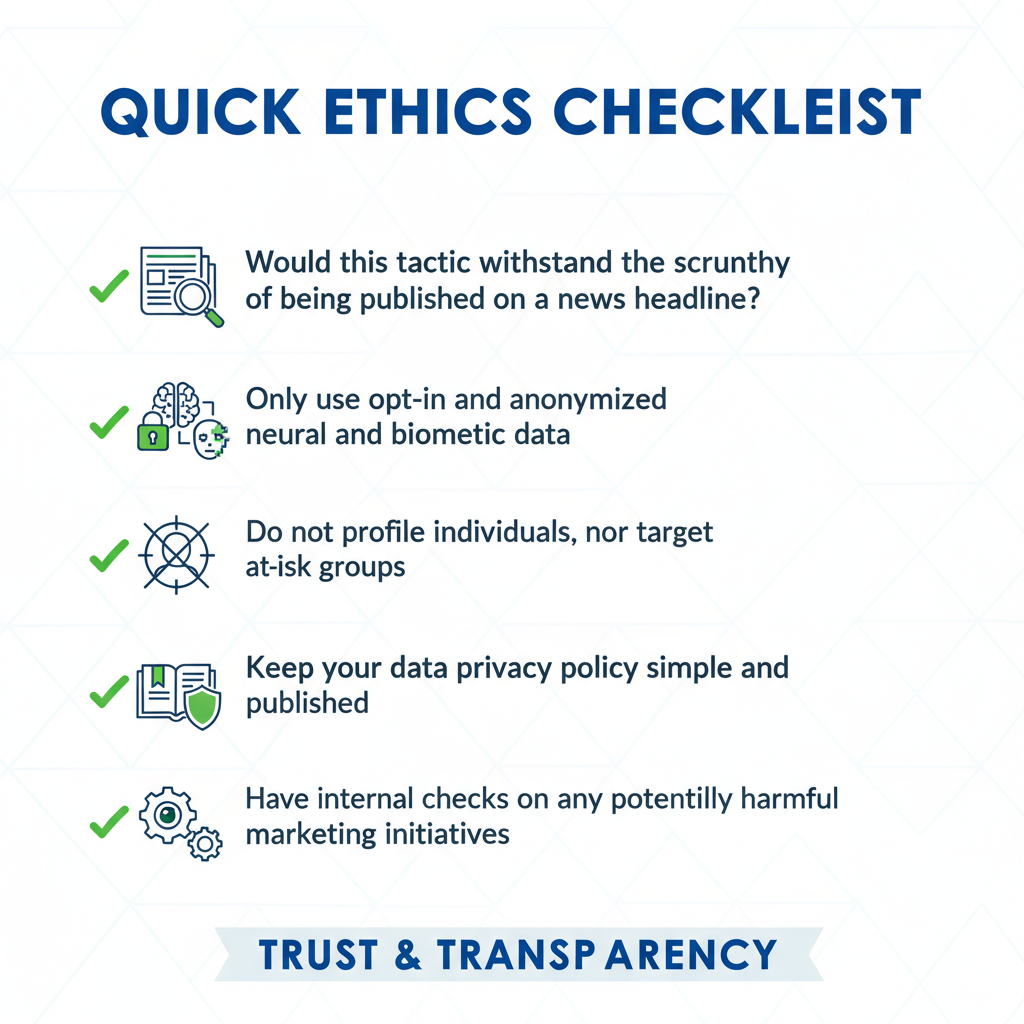
Quick Ethics Checklist:
- Would this tactic withstand scrutiny if published as a news headline?
- Only use opt-in and anonymized neural and biometric data.
- Do not profile individuals, nor target at-risk groups.
- Keep your data privacy policy simple and published.
- Have internal checks on any potentially harmful marketing initiatives.
Cut to the chase
Ethical marketing is not about interfering with the brain; it is about respecting it. Use data with consent, influence with honesty, and establish trust that lasts longer than a click. Do you want to make persuasion powerful and ethical? Let’s create it correctly.