

Welcome to Agentic Marketing & The Era of Self-Driving Campaigns
Marketing has officially entered the era of self-driving. Where autonomous cars don’t wait for drivers to steer, agentic AI doesn’t wait for marketers to click, approve, schedule, or analyze.
It thinks, acts, and adapts seamlessly. These AI agents don’t just facilitate campaigns—they run them from start to finish. From writing ad copy to optimizing budgets and tweaking creatives in real-time, agile marketing is transforming marketing workflows. The rise of this new wave isn’t just about faster automation or more innovative tools—it’s about AI with agency.
Think of them as digital teammates for your marketing team that don’t sleep, don’t guess, and don’t need coffee during a long meeting. And while it sounds futuristic, agentic AI isn’t retro; it’s running campaigns quietly as you read, across sectors and industries.
What is agentic marketing, anyway?
Agentic marketing is a transformation from automation into autonomy. You’re moving beyond automation—the kind that sits there, waiting for you to click ‘go.’
Instead, marketing AI agents means the agent is programmed with a goal—for example, “increase conversions by 20%” and then decides how to achieve it. The AI agents will research audiences, generate creatives, test formats, allocate budgets, and enhance or shut down poorly performing campaigns without requiring any marketer approval for these steps.
Unlike automation (which involves rule-based, repetitive task execution), AI agents operate through a sense-think-act loop. They will analyze new data, make informed decisions, and act on insights in real-time. They are not assistants; they are decision makers.
The process explained—no sorcery, only machine logic
Here is the breakdown of an agentic marketing workflow:
- Goal setting: The only one where humans step in—identifying what success will look like. For example, “Generate 500 high-value leads for $10,000.”
- Data sweep: Artificial Intelligence pulls insights from customer relationship management systems, social listening tools, ad platforms, and web analytics.
- Strategy building: It will create the creatives, segment audiences, identify influencers, create your landing page, and allocate budgets.
- Campaign launch: Ads are automatically placed on the platforms where your audience is scrolling—such as TikTok or LinkedIn.
- Self-optimization: The agent will monitor in real-time and optimize the bid, visual, intro, and format used for optimal performance.
- Review & Reporting: At the end of a cycle, it will provide results and recommendations—no micromanagement involved, just maximum output.
Reasons why brands are making large investments in it
Because agentic marketing addresses the most prominent pain points marketers are grappling with today:
- Speed to market: Two weeks of brainstorming, design, and approval now take two hours.
- Cost efficiency: It reduces wasteful ad placements, reallocates spend into high-returning audiences, and keeps ROAS (Return on Ad Spend) under control.
- Personalization capability: It produces thousands of ad variations by targeting users based on micro-personas, behavior patterns, and even mood signals.
- Always-on execution: no weekends and burnout. It works 24/7, analyzing and acting.
Brands, such as Coca-Cola, are testing AI-driven creative assets, while e-commerce brands are utilizing AI agents for seasonal sale campaigns and are already lowering costs and speeding up conversions.
The human–AI collaboration zone
Let’s be real: AI isn’t replacing marketers; it is replacing manual marketing. Humans still determine the narrative, brand voice, and ethical boundaries; AI simply executes.
Humans are better at:
- Crafting brand stories and emotion-based messaging
- Maintaining ethical boundaries—no creepy retargeting or misinformation
- Recognizing culture, humor, and human behavior
AIs are better at:
- Scaling content 10x faster
- Analyzing data reliably and without fatigue
- Reacting instantaneously to changes in the market (like that trending sound, keyword surge, or competitor drop)
The smartest marketers are not resisting agentic systems—they are learning to teach, monitor, and refine them.
Examples from the real world: How it works
These are not just examples—it is taking place. Brands are already using AI to plan, create, and optimize real-world, live campaigns that take place in the moment.
Here’s how agentic marketing works with fashion, fast food, and streaming services.
“Ask Ralph”—Ralph Lauren
Ralph Lauren launched “Ask Ralph,” an AI-powered styling assistant within its app (via Microsoft/OpenAI ChatGPT), which has been trained on decades of brand archives.
This allows users to input questions about outfits and receive personalized responses directly within the app in the U.S.
AI-Powered Ordering & Marketing—Papa John’s
Papa John’s announced a partnership with Google Cloud in 2025 that will utilize AI to send push notifications, loyalty offers, and support chat-based ordering. The plan is to shift away from manually triggering campaigns to a more streamlined, personalized approach.

i Vision Dee—BMW
In 2025, the i Vision Dee campaign unveiled a color-shifting concept vehicle, integrating an AI-generated narrative and a virtual brand ambassador, which merged elements of a vehicle reveal, creative technology, and immersive storytelling.
Let’s be frank—some challenges need to be addressed
Agentic AI offers both freedom and responsibility.
- Creativity deficits: AI is remixing, but can it create something as culture-shifting as the campaigns Nike did with ‘Just Do It’?
- Bias in data: Bad data in means insufficient data out. If AI is trained on bad data, it will safely optimize the wrong audiences.
- Ethics: AI can and will create manipulative strategies given the opportunity. It can manipulate user behavior or invade privacy.
- Career insecurity: Expanding roles like media buying, campaign scheduling, and performance reporting are being reshaped—not pipe dream jobs being taken away.
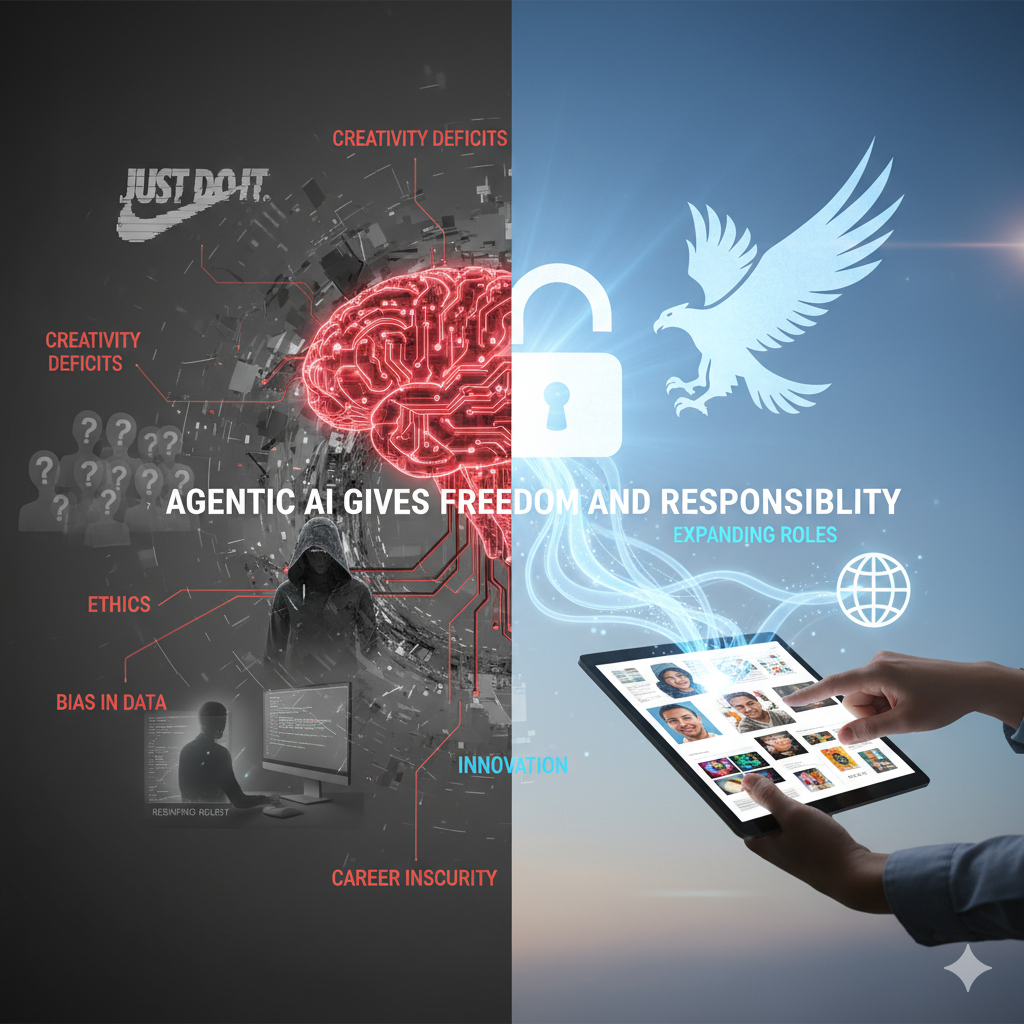
That’s precisely why AI should be used, and not without human oversight. It is somewhat similar to the regulation of a plane. The plane flies, and a human is still in the cockpit, checking in.
The skills marketers need now
According to agentic marketing, it does not require coders—it requires strategic doers. This is what future-focused marketers are learning:
- Prompt Engineering: Clear written goals and constraints for digital agents.
- Data Fluency: Knowledge of what metrics mean, dashboards, and prediction logic.
- Creative Oversight: Approval of brand tone, visuals, and narrative arcs.
- AI Ethics & Compliance: Awareness of where the line in the sand is drawn. Because customers care.
If you can help guide AI and not fear it, you are not replaceable; you are indispensable.
So …is this the end of the traditional marketing campaign?
Almost—but it’s the end of manual everything.
Marketing capacity is transitioning from execution-heavy to THINKING-heavy roles. From campaign managers to AI conductors. From “launch and pray” to “launch designate and auto-optimize.”
Agentic marketing is not the future; it’s the present quietly taking over, one marketing campaign at a time. Those who embrace it early will save time and their own attention.
Cut to the chase
AI does not simply assist marketers; it is driving full campaigns independently. Algorithmic marketing is, in fact, discretely replacing performing work with agentic decision-making—from writing copy to optimizing budgets instantly in execution.
Want a full breakdown or a custom response for your own brand? Just ask.