

What Is Data Governance? Tools, Strategy & Software That Turn Data into Results
Raw data on its own doesn’t create value. Without structure, quality, and control, it leads to confusion, poor decisions, and compliance risks. Data governance changes that turn scattered, unstructured data into a reliable business asset that drives real outcomes.
As economies evolved from agriculture to industry to services, businesses moved from simply collecting data to actively governing it. Today, the most successful organizations are those that use governed data to gain a competitive advantage.
Let’s explore how data governance, governance software, and access controls work together to turn data into strategy.
Data governance, software & access control: The system that keeps data in check
It is a framework that ensures an organization has a consistent, secure, accurate, and accessible data resource. Data governance sets the rules, while software and access controls ensure they are consistently followed throughout the data lifecycle. Together, they help convert data from a confusing resource into a structured, dependable business asset.
To make it easier, let’s break down these three components and see how they work together to keep data in check:
Data Governance (The Foundation): Data governance sets the rules for how data is managed—ensuring it is accurate, secure, consistent, and accessible to the right people at the right time.
Data Governance Software (The Enabler): To bring these rules into action, data governance software automates and enforces them across the data lifecycle. It helps standardize definitions, track data lineage, manage access, and continuously monitor data quality at scale.
Data Access Governance (The Gatekeeper): Focusing specifically on control, data access governance defines who can access data, when, and under what conditions. It plays a critical role in protecting sensitive information, ensuring compliance, and building trust across the organization.
Why data governance matters more than ever
Businesses today are flooded with data from CRMs, social platforms, IoT devices, and more. Without governance, this leads to silos, inconsistencies, and unreliable insights.
Having a robust governance program provides value in several ways:
- Breaks down siloed data between departments
- Creates consistency in how data is used throughout the company
- Lowers the risk of misuse/error in the utilization of data
- Provides enhanced opportunities for analytics/AI capabilities
Organizations that demonstrate mature levels of governance tend to extract significantly more measurable value from their data than those with less mature governance practices.
Key benefits of data governance
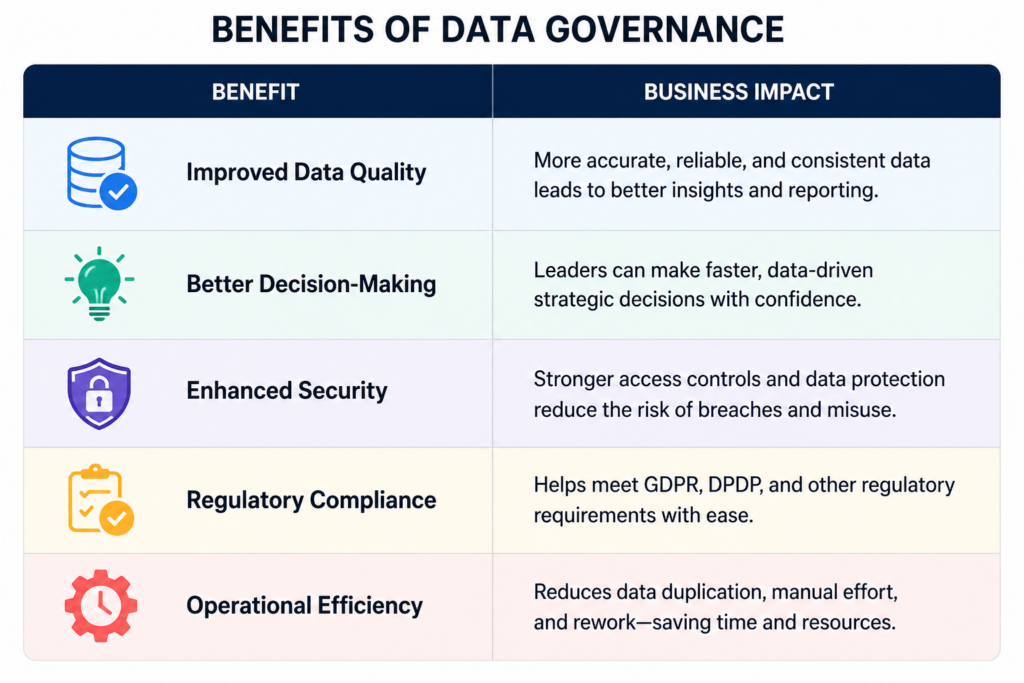
- Higher Data Quality: Good governance ensures data is trustworthy, accurate, complete, and dependable. High-quality data leads to better results when analyzing and reporting.
- Superior Decision Making: When leaders feel confident in their data, as a result, they can make faster and more informed strategic decisions, eliminating the need for guesswork.
- Improved Compliance/Security: With a strict set of policies and supervision in place, companies can fulfill regulatory requirements and minimize the risk of a data breach.
- Increased Efficiency in Operations: Standards for the collection and processing of data reduce duplicate entries, inaccuracies, and manual labor, saving time and money.
- Improved Teamwork: Team Governance will help create a common understanding of data among the multiple teams, resulting in increased cross-team collaboration.
How data governance software drives business strategy
Data governance software is much more than just the means to manage data; it’s the foundation for developing a strategy. The following are all areas in which governance facilitates and drives strategy.
- Provides Real-Time Data Insights: Governance allows for actionable and reliable insights from analytics. Without governance of your data, analytics outputs can be misleading.
- Creates a Data-Driven Culture: By providing access to high-quality data, governance will create an environment where all employees can make informed decisions based on the same reliable data.
- Provides Clean Data for AI and Advanced Analytics: Clean Data is essential for the success of an AI system. Governance provides clean, immutable, well-governed data to ensure that the training dataset is valid, compliant, and ready for machine learning.
- Connecting Data Use to Business Objectives: The use of a governance framework enables the connection between data usage and the organization’s objectives. By providing a governance framework, organizations can ensure that their data-related initiatives align with their strategic priorities for their desired outcomes.
In fact, Gartner predicts that through 2026, organizations will abandon 60% of AI projects due to a lack of AI-ready data, reinforcing how critical strong data governance is to successful AI outcomes.
Key features of data governance software
The capabilities commonly found in many modern data governance tools include the following:
- Data cataloging: Organizes and indexes the data, allowing you to easily search for and access the information you need.
- Data lineage tracking: Tracks where the data originated, how it has moved through multiple systems, and provides a detailed trail of the data’s movement through its life cycle (this supports transparency and accountability).
- Data quality management: Ensures that data meets required quality standards (e.g., accurate and consistent).
- Policy management: Creates rules for how data is used/managed/secured and enforces them.
- Access control: Assigns permissions (based on employee roles) for accessing sensitive information.
- Metadata management: Provides reference information on data, allowing users to understand its meaning and context.
Types of data governance tools
There are several types of tools that can be used for data governance, including:
- Data quality tools – Improve accuracy and reliability
- Data catalog tools – Enable discovery and accessibility
- Master data management (MDM) tools – Maintain consistency across systems
- Compliance and security tools – Ensure regulatory adherence
Each of these tools is an important part of the overall governance framework.
Enterprise data governance: Scaling strategy
Scaling an organization’s data governance program across the enterprise requires alignment between your organization’s data management processes and its overall business strategy. Then, data governance relies on:
- Cross-department collaboration
- Defined roles like Chief Data Officer (CDO)
- Organization-wide policies and standards
- Integrated governance tools
At this level, data governance shifts from a technical function to a strategic capability.
Best data governance software (Examples)
While the right choice depends on business needs, some widely recognized tools include:
- Collibra
- Informatica Data Governance
- Microsoft Purview
- Alation
- IBM InfoSphere
These tools provide the enterprise-level capabilities needed to build and sustain a strong data governance framework, enabling organizations to turn data into actionable insights. This growing importance is reflected in market trends, with the global data governance market projected to expand from $3.35 billion in 2023 to $12.66 billion by 2030, driven by rising data complexity and increasing regulatory demands.
Some effective data governance strategies for better results
All businesses must have a proper plan in place to utilize their data as effectively as possible to reach the objectives of their business.
- Start with Business Goals: Align your data governance strategy with core objectives like growth, compliance, or customer experience.
- Develop the Right Roles and Responsibilities: Establish which individuals within your business will have responsibility for both managing and governing your data.
- Use the Right Technology: Evaluate which software applications will work best with your existing systems and can grow with your business.
- Prioritize Data Quality: Quality data is necessary for the success of any Data Governance Program.
- Promote a Data-driven Culture: Encourage everyone to have the right mindset and to use their data effectively.
Future of data governance and its challenges
Data Governance has proven to be beneficial; however, implementing it into an organization can be challenging due to resistance from the organization, data silos, difficulty with integrating tools, and unclear ownership of the data. Strong leadership, clear accountability, and a well-defined strategy are all required to help overcome these obstacles.
Data governance will continue to become more important in the future as artificial intelligence (AI) and real-time analytics become more mainstream. Results of AI-driven automation, real-time monitoring, ethical data usage, and integration with data mesh.
Like architectures will be key trends impacting the future of data governance; as a result, data governance will not only be used as a means of controlling data but will also actively drive innovation.
Cut to the chase
Data governance often breaks down due to siloed systems, unclear ownership, and a lack of accountability; as a result, this leads to slower decision-making, increased risk, and lost data value. As AI and real-time analytics grow, strong data governance is no longer optional—it’s a competitive edge.
FAQ’s
Data governance software is a set of tools that help organizations manage, control, and protect their data by enforcing policies, ensuring data quality, and enabling secure access across systems.
Data governance ensures data is accurate, secure, and consistent, which helps businesses make better decisions, reduce risks, and stay compliant with regulations.
By providing reliable, high-quality data, governance eliminates guesswork and enables faster, more informed business decisions