
The AI Readiness Gap Is Holding Commerce Back in 2026
Brands and retailers feel pressure to protect their margins and keep operations stable, while also needing to innovate and grow. This tension is shaping commerce strategies as we head into 2026.
It’s clear that adding more tools won’t make businesses faster or more agile. Real speed comes from having clean, connected data that helps teams work quickly and smoothly.
Industry reports for 2026 highlight the AI gap, skill shortages, and changing consumer behavior. AI is both the biggest promise and the most overlooked problem for brands and retailers. As 2026 gets closer, the gap between plans and action is growing quickly.
Getting ready for 2026 means more than just overcoming challenges. It also requires keeping consumer loyalty and trust by using clear data. With that in mind, let’s look closely at the AI gap and the weak points in the commerce industry for 2026.
Everyone wants to use AI, but are they truly prepared for it?
Rithum, a connected commerce platform, surveyed 200 executives in the US and UK. Only one in four leaders feel ready, skilled, and confident to adopt AI and automation quickly. What about the rest?


You can say that they are somewhat unconfident or, at the least, not confident at all in their skills or resources to adopt AI at full capacity.
Even in 2026, the commerce industry—both retailers and brands—still faces skill gaps. Leaders say budget and skill shortages are their biggest internal obstacles to growth.
In today’s volatile market, where one TikTok trend can empty the entire inventory, a laid-back reaction and inaction to these internal hurdles may erode a quarter’s edge.
Enablement of AI in commerce is the top priority
According to Rithum’s report, 47 percent of retailers and 37 percent of brands are prioritizing AI enablement across company operations, while 42 percent of brands are funneling efforts into broader digital transformation.
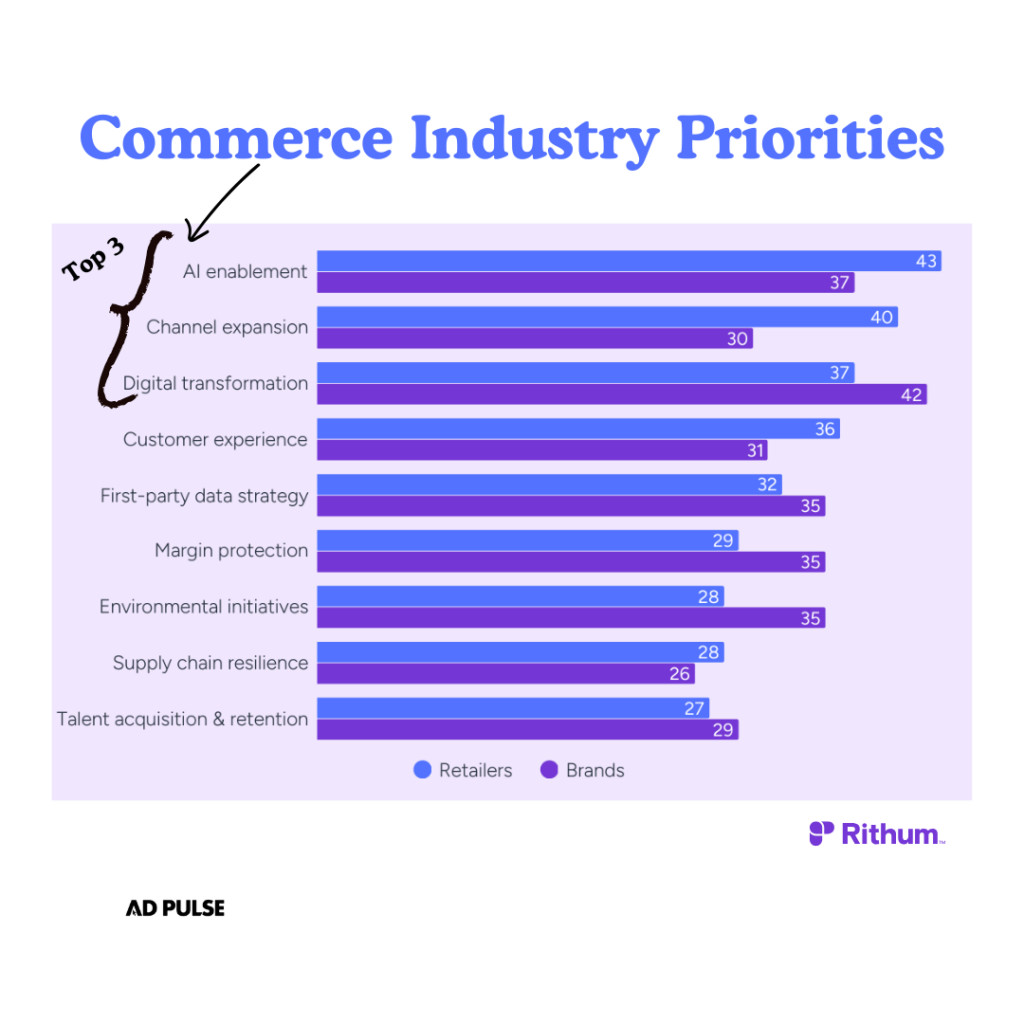
The intention to use AI is clear, but actual readiness varies. Many organizations are rushing to use AI without fully understanding how it fits into their current systems, workflows, or data.
Subscribe to our bi-weekly newsletter
Get the latest trends, insights, and strategies delivered straight to your inbox.
This gap has real consequences. Poor data weakens AI performance and leads to bad decisions. When teams use low-quality or inconsistent data, the AI produces weak insights, misplaced confidence, and costly mistakes.
If you move quickly with bad data, you end up redoing work, wasting money, and making mistakes. Most retail and brand leaders admit they still rely on outdated or incomplete data, and nearly half say that 26 to 50 percent of their workflows are still manual, like using spreadsheets or manual approvals.
This slows decision-making to the pace of spreadsheets, hurting agility when speed is crucial. Until data systems and AI skills improve, ambition alone won’t make commerce ready for AI in 2026.
AI in the Commerce Industry has faulty foundations
Many commerce leaders still see AI as a shortcut—a faster way to analyze data, create content, or answer customers—instead of as a system that requires real structural change.
Almost three out of four commerce leaders admit they’re already behind on adopting AI. This gap is real. Slower companies waste money on experiments, while faster ones use AI, move ahead, and change what customers expect.
AI is no longer just a test project—it’s becoming part of core operations. Around 41 percent of retailers and 29 percent of brands already use automation in several areas, and another 57 percent of brands and 41 percent of retailers plan to start soon. There’s little room left for those who hesitate.
As competitors use AI to improve pricing, inventory, and marketing, those lagging are falling further back.
Ironically, the companies making AI a priority are also struggling with the very problems that hold it back. Nearly half of retailers and 62 percent of brands say manual processes still dominate their work, and poor data quality affects 91 percent of retailers and 78 percent of brands.
This contradiction is why AI is now a top priority. For teams overwhelmed by inefficiency, AI seems like a way out. But if data quality and manual work aren’t fixed first, AI just makes the problems worse.
Be ready for consumers before it’s too late
AI may handle much of the work in commerce, but consumers still come first. While automation can enhance operational efficiency, the primary challenge remains: preparing teams for an evolving consumer journey. The essential question for leaders is: what specific consumer pain point will this AI project address?

This forces businesses to align AI initiatives with real shopper friction, enhancing relevance, and retaining consumer loyalty. Without addressing these fundamental issues, even the most advanced AI will struggle to maintain brand relevance.
At Ad Pulse, we’ve said this repeatedly: the consumer journey is no longer linear.
The consumer’s journey is now unpredictable and fragmented, and AI has made this even more true. Gen Z, younger millennials, and Gen Alpha spend their time on AI-powered apps and digital platforms. Discovery, consideration, and purchase often occur simultaneously, sometimes without brands being aware of when or where the decision was made.
Retail media networks highlight this change. Ads now appear at the moment shoppers are most interested, such as in Amazon search results, on sponsored shelves in Walmart’s app, or as “related products” at online grocery checkouts.
These ads aren’t just for awareness—they influence decisions right at the point of purchase. Still, even as brands adjust their channels, operational gaps continue to slow them down.
Commerce is now in a phase where AI acts on behalf of consumers. It tracks what they like, predicts their needs, and creates highly targeted experiences instantly. For brands, the real risk isn’t slowing AI adoption—it’s not reorganizing teams, data, and decisions around consumers who move faster than their systems.
The balancing act is not balanced
Last year, economic instability, tariffs, and the growth of AI disrupted the commerce industry for both retailers and brands. In 2026, they are racing toward an AI-powered future, but the numbers tell a different story.
This is where the AI gap stands out. AI may be the top priority, but many aren’t ready, and execution is inconsistent. Even more concerning, consumer experience isn’t even among the top three priorities for brands and retailers—a risky oversight as AI shapes how, when, and why people make purchases.
Cut to the chase
Focusing on AI in commerce won’t lead to growth unless data, workflows, and internal skills are improved. In 2026, brands and retailers must combine innovation with strong operations, act quickly with clean data, close the AI readiness gap, and rebuild their strategies around the consumer journey.