May Marketing Rundown: 6 Must-Know Stories That Shaped the Month
The marketing industry is navigating significant change amid ongoing economic uncertainty and a volatile business environment. The major developments of May suggest that restructuring and operational reinvention have become priorities for both brands and agencies. Scrutiny around AI is intensifying; layoffs continue to rise across the technology sector, and social platforms are facing increasing pressure from investors to demonstrate sustainable growth.
From Meta to X, companies are increasingly exploring subscription-based and premium business models to diversify revenue streams, even as they continue to generate billions in profits. As platforms search for new sources of growth beyond advertising, it would not be surprising to see subscription offerings become a larger part of social media strategies in the near future.
The May marketing landscape presents a mixed picture—one shaped by cost-cutting, AI investments, and new monetization experiments. At the same time, it offers insight into the strategic direction many brands and platforms appear to be taking.
Let’s take a look at the major marketing and advertising stories that defined May 2026.
Spotify Reverts to Classic Logo Design Following User Backlash
Spotify restored elements of its older app icon and visual branding in May 2026 after widespread criticism of its recent design updates. Users across social platforms and online forums had complained that the newer icon variations reduced brand recognition and created inconsistencies across devices and interfaces.
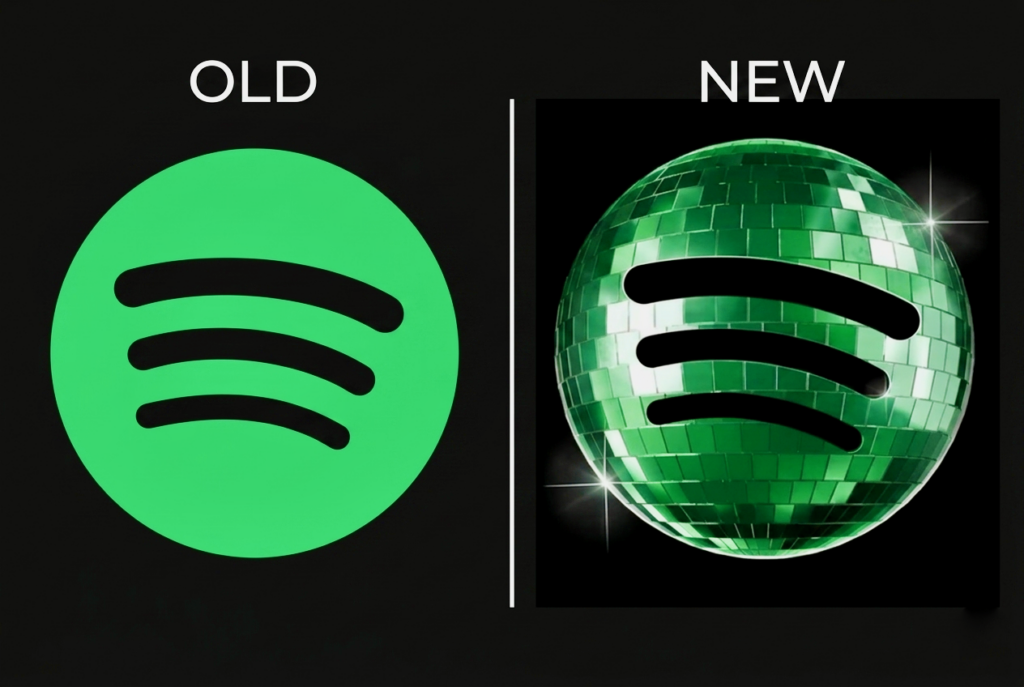
The company confirmed adjustments to its mobile app branding, bringing back a darker green palette and simplified visual structure closer to Spotify’s previous identity system. The update rolled out gradually across iOS and Android platforms in the United States, the UK, and Europe.
The reversal reflects growing sensitivity among technology companies to user familiarity and interface consistency, particularly as platforms continue to redesign products to accommodate AI-powered features and new discovery systems. The response also highlights how visual branding changes can quickly become consumer-facing issues in highly competitive digital ecosystems.
Meta Introduces Paid AI Chatbot Subscriptions to Offset Rising AI Costs
Meta launched paid subscription tiers for its AI chatbot platform in May 2026 as the company seeks to monetize its expanding AI infrastructure investments. Bloomberg broke this story. The new offerings, branded under “Meta One,” include two consumer plans priced at $7.99 and $19.99 per month, giving users higher limits for image generation, video creation, and advanced reasoning tools.
The rollout also includes subscription plans for Facebook, Instagram, and WhatsApp, as well as business- and creator-focused services. Meta executives stated that the subscriptions are intended to diversify revenue streams beyond advertising as AI spending accelerates.
The move comes amid growing investor scrutiny over Meta’s AI expenditures, which are projected to reach as much as $145 billion in 2026. While Meta argues that AI already improves advertising efficiency and targeting, the company is now under pressure to demonstrate direct commercial returns from its broader AI ecosystem.
Microsoft and Enterprise Clients Reassess AI Spending Priorities
Enterprise companies across the US and Europe continued to reassess AI investment strategies in May 2026, with Microsoft remaining central to discussions on enterprise AI adoption and monetization. Reports showed that many companies are slowing expansion plans until clearer productivity and financial outcomes are demonstrated.
While tools integrated into Microsoft’s enterprise ecosystem continue seeing adoption, businesses are increasingly demanding evidence of measurable ROI before committing to broader deployment. The trend reflects a wider shift across the marketing and technology industries, where AI investment is moving from experimentation toward performance accountability and operational efficiency.
Google Expands AI Search Advertising at Google Marketing Live 2026
Google used its May 2026 Marketing Live event to introduce expanded advertising placements inside AI-generated search experiences. Ads will now appear more prominently within conversational search summaries and recommendation interfaces powered by generative AI.
The company also launched upgraded AI tools for creative production, automated campaign setup, and predictive audience targeting. Advertisers can generate image and video assets directly within Google Ads using text prompts and performance signals.
The announcements reflect Google’s push to maintain dominance in search advertising as user behavior shifts toward AI-assisted discovery. The changes also reduce manual campaign control, increasing reliance on automation and platform-driven optimization systems.
X Rebuilds Advertising Platform Around AI Infrastructure
X announced a rebuilt advertising platform in May 2026, introducing AI-powered systems for campaign creation, targeting, ranking, and ad placement. The rollout is part of the company’s broader effort to recover advertising revenue and improve performance for marketers after years of advertiser uncertainty following ownership changes.
The new infrastructure uses AI to automate audience targeting, campaign optimization, and ad delivery decisions. X stated that the rebuilt system is designed to improve relevance and efficiency while enabling faster deployment of future advertising tools. The update reflects a wider industry shift toward machine-led media buying, where platforms increasingly control optimization rather than advertisers manually managing campaigns.
Meta Cuts 8,000 Jobs as AI Restructuring Accelerates Across the Company
Meta carried out one of its largest workforce reductions in recent years during May 2026, laying off approximately 8,000 employees, or about 10% of its global workforce, as part of a broader restructuring centered on artificial intelligence. The company also froze roughly 6,000 open roles while reallocating around 7,000 employees into AI-focused teams and workflows.
CEO Mark Zuckerberg linked the changes to rising AI infrastructure spending and the company’s long-term AI strategy, describing AI as Meta’s most significant technology priority for future growth. The move reflects a wider trend across the technology and advertising sectors, where companies are reducing headcount while redirecting investment toward AI development and automation.