
Consistency, Familiarity, and the Super Bowl: Vanessa Chin on Brand Trust in 2026
As brands enter another year of economic pressure, AI-accelerated creativity, and shortened attention spans, consumer trust in brands isn’t eroding because advertising lacks ambition. It’s eroding because it lacks familiarity.
Talking exclusively to Ad Pulse, Vanessa Chin, SVP of marketing, System1, predicted what brands could do with their Super Bowl ads in 2026 to increase their recall value.
“When I think of trust, I think of building relationships with consumers and being recognizable,” says Chin.
In an era obsessed with reinvention, recognizability may be the most undervalued brand asset. Let’s dive deep with Vanessa Chin on why trust is critical for authentic branding and how to bring it back in 2026.
Sidelining consumer trust is a branding issue
For years, brands have treated trust as a value problem, something to be solved with purpose-driven messaging or mission statements. But consumers don’t experience trust as a belief system. They experience it as a pattern.

Before an ad can persuade or entertain, it must first be understood. And that understanding starts with immediate brand recognition. If viewers can’t quickly tell who’s speaking to them, trust doesn’t even enter the conversation.
In 2026, trust will increasingly be a branding problem, not a communications one.
The Crackle-Barrel rebranding fiasco, which happened in 2025, pushed the discussion on consumer trust and consistency forward. The brand attempted a sleek, modern redesign and logo update by shedding its recognizable, traditional identity, alienating loyal customers.
The backlash was so severe that the brand quickly reversed course and reinstated its original logo.
This is a perfect example of consistency, especially in heritage brands, which builds trust, while drastic departures without recognizable continuity can do the opposite.
Creative consistency is the shortcut to consumer trust
According to Chin, creative consistency will remain critical for earning consumer trust in 2026, especially when it’s used positively through fluent brand devices. These include recurring characters, familiar slogans, or recognizable brand worlds that allow audiences to identify the advertiser faster and earlier.
Subscribe to our bi-weekly newsletter
Get the latest trends, insights, and strategies delivered straight to your inbox.
We have three major brand names that consistently use characters, familiar voices, sound effects, messaging, and colors to stay at the top of the game.
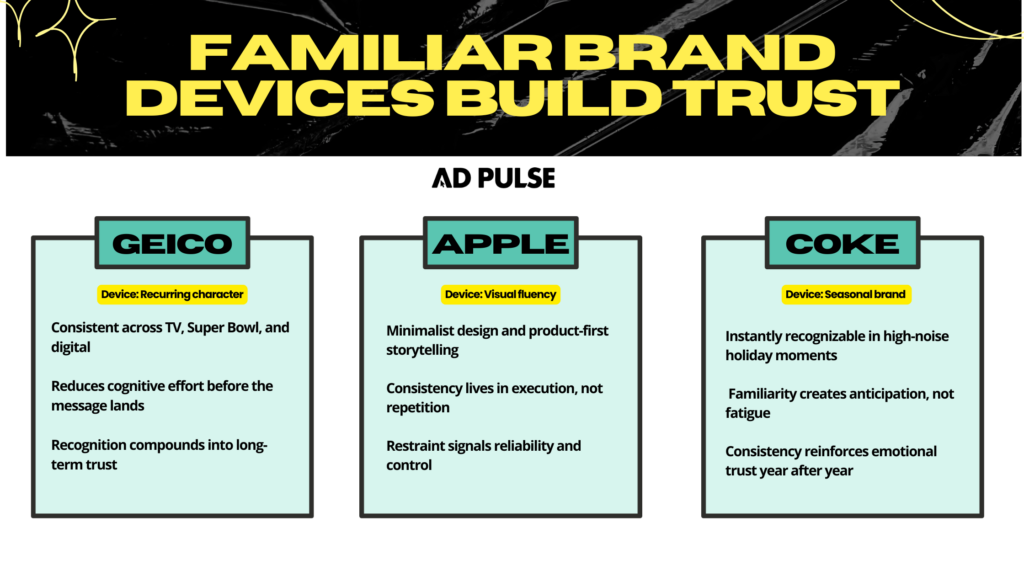
Consistency lowers cognitive effort. It creates emotional safety. And over time, it builds trust not through explanation, but through repetition.
In a fragmented media environment, brands that look and sound like themselves every time don’t just stand out—they feel dependable.
The Super Bowl: Where consistency gets put on trial
A few moments test this principle more brutally than the Super Bowl.
With hundreds of millions of dollars poured into a single night of advertising, the Super Bowl is one of the most crowded branding environments of the year. It’s also where brands are most tempted to chase novelty—new characters, new tones, new identities—in the hope of being remembered.
But familiarity, not spectacle, is what helps audiences latch on immediately.
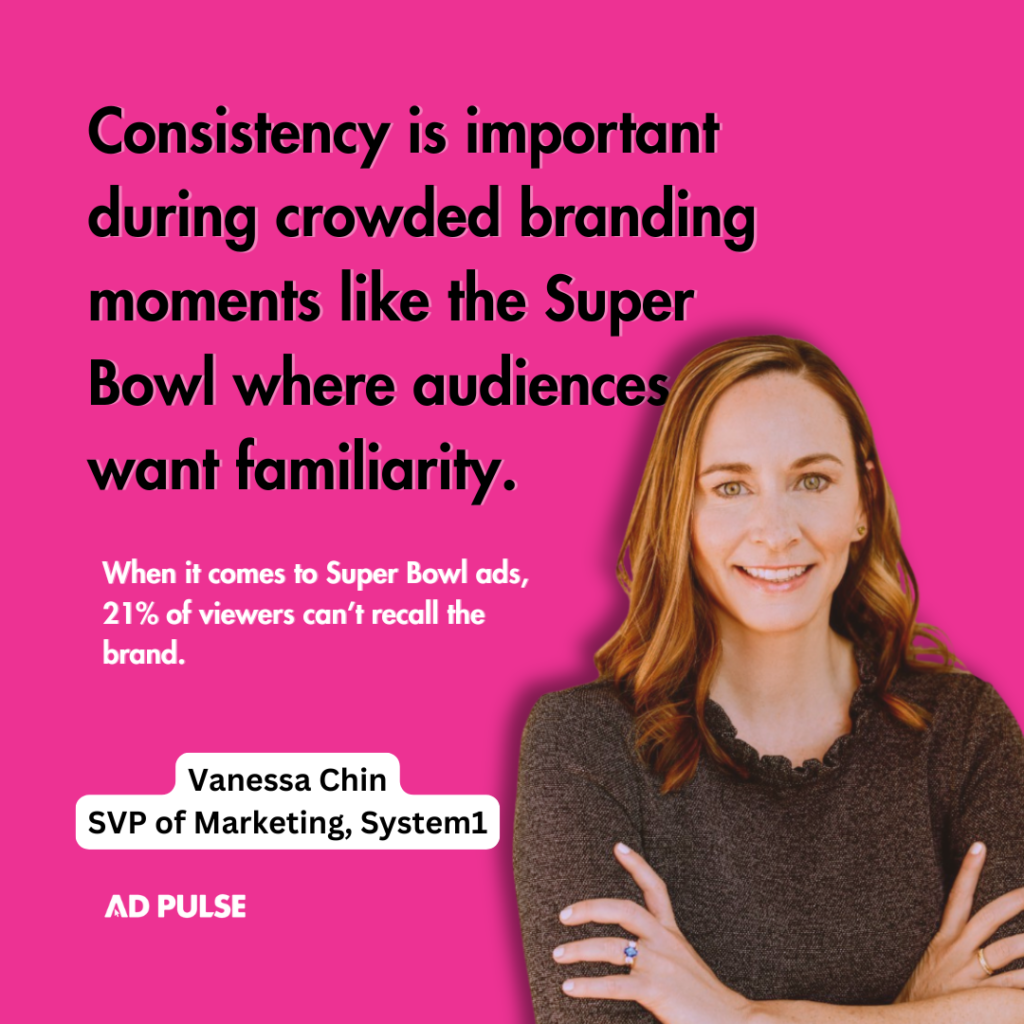
“This is especially important during crowded branding moments like the Super Bowl, where audiences want familiarity they can recognize right away,” Chin notes.
And the data backs it up.
The cost of chasing novelty
System1’s research consistently shows that novelty becomes a liability when it comes to the expense of recognition. One of the clearest signals: when it comes to Super Bowl ads, 21% of viewers can’t recall the brand.
The problem isn’t that the ads fail creatively. It’s that brands often double-dip on confusion—introducing both a new idea and a new identity at the same time. Viewers are left trying to decode what they’re watching instead of remembering who it’s from.
In a high-stakes moment like the Super Bowl, that confusion is expensive.
Novelty without recognition doesn’t build trust. It delays it.
What smart brands will do differently in 2026
As brands look ahead to 2026, the winners won’t be the loudest or the most experimental. They’ll be the most fluent.
That means:
- Investing in long-term brand assets instead of one-off campaign ideas
- Refining recognizable worlds rather than reinventing identities
- Treating consistency as a performance driver, not a creative limitation
In a market where consumers are overwhelmed by choice and fatigued by constant reinvention, familiarity becomes a form of respect.
Recently, Dos Equis made its “the most interesting man in the world®” return, this month.
“Our research found that 83% of people exposed to the original campaign wanted to see it return, and the old ads drove an incredible 97th percentile brand recall in recent testing”.
Alison Payne, CMO, The HEINEKEN Company USA
Trust is built before the big moment
The Super Bowl doesn’t build trust—it exposes whether a brand has already earned it.
Brands that show up recognizable give trust a head start. Brands that show up unrecognizable ask audiences to work harder than they’re willing to.
In 2026, trust won’t belong to the brands that try something new every time. It’ll belong to the ones that knew who they were long before the spotlight hit.
Cut to the chase
When brands stray too far from what people already associate with them, they weaken the mental shortcut that recognition provides, and you can’t build trust without recognition. Vanessa Chin shared her insights on the brand marketing trend in 2026.