How Synthetic Audiences Are Tackling Marketing’s Predictability Problem
What if marketers could test campaigns on thousands of consumers before launching them, without recruiting a single focus group participant or waiting weeks for survey results?
That idea sits at the center of synthetic audiences, an emerging approach that uses AI to simulate how different consumer segments might respond to ideas, campaigns, or products. Instead of collecting responses from real participants, AI models generate responses from virtual populations designed to mirror real-world demographics and behavioral patterns.
One company exploring this model is Electric Twin, founded by former British Army commander Alex Cooper. After spending two decades in the British Army and later leading the UK’s mass COVID testing program during the pandemic, Cooper saw firsthand how often leaders are forced to make critical decisions with incomplete insight into how people will behave.
In this conversation with Ad Pulse, Cooper discusses why predicting human behavior remains one of the hardest challenges in marketing—and how synthetic audiences could reshape the way brands test messaging, campaigns, and consumer insights.
Marketing’s persistent decision problem
Marketing has always involved a degree of guesswork. Campaigns are debated internally, focus groups are conducted, and surveys gather opinions, but translating those insights into real-world behavior remains challenging.
According to Cooper, the problem isn’t limited to marketing.
“Businesses struggle with predicting human behavior in fast-moving environments and high-stakes decisions are often made with incomplete data.”
Alex Cooper explains that he saw this problem repeatedly during his time leading the UK’s national COVID testing program from Downing Street.
Alex Cooper:
“A pint with Ben Warner. I had worked closely with Ben through the Covid pandemic and really enjoyed his spark. So, when he proposed setting up a business it didn’t take much to convince me that it would be a laugh.
It also helped that I could see the potential for us to solve some massive challenges. During my time leading the UK’s mass testing program in No.10, we were making high-stakes decisions at pace, often with incomplete information about how millions of people would behave.
Traditional research and behavioral science methodology couldn’t operate at the speed or scale required. This isn’t a problem that’s constrained to the pandemic or government: businesses struggle with predicting human behavior in fast-moving environments.”
Subscribe to our bi-weekly newsletter
Get the latest trends, insights, and strategies delivered straight to your inbox.
For Cooper, this gap between decision speed and research speed became the starting point for building Electric Twin.
How synthetic audiences work
Traditional research methods such as surveys, focus groups, and panels, remain valuable tools. But they are often slow to deploy and difficult to iterate once a study begins.
Synthetic audiences aim to complement those methods rather than replace them.
“Instead of running a static study, marketers can simulate how populations will respond with comparable accuracy to traditional surveys, but with greater flexibility.”
Alex Cooper:
“Traditional surveys and focus groups will always have their place. We see a future of high-quality real-world research being complemented by synthetic tooling.
But marketers know how long it can take to design, field and analyze research — and how difficult it is to iterate a survey once it’s live.
Synthetic audiences change that dynamic. Marketers can test, refine and test again, moving from quant to qual and back. They can drill into segments, follow gut instinct, and pressure-test hypotheses. These are all things marketers don’t typically have the time or budget to do using traditional methods.”
The advantage, he says, lies in experimentation. Teams can explore multiple directions before committing marketing budgets to campaigns.
Marketing in the post-Cookie Era
The rise of synthetic audiences also intersects with one of the advertising industry’s biggest shifts: the collapse of traditional tracking infrastructure.
Third-party cookies are disappearing, privacy regulations are tightening, and many brands are reassessing how they gather audience insights.
Cooper believes synthetic modeling offers an alternative path.
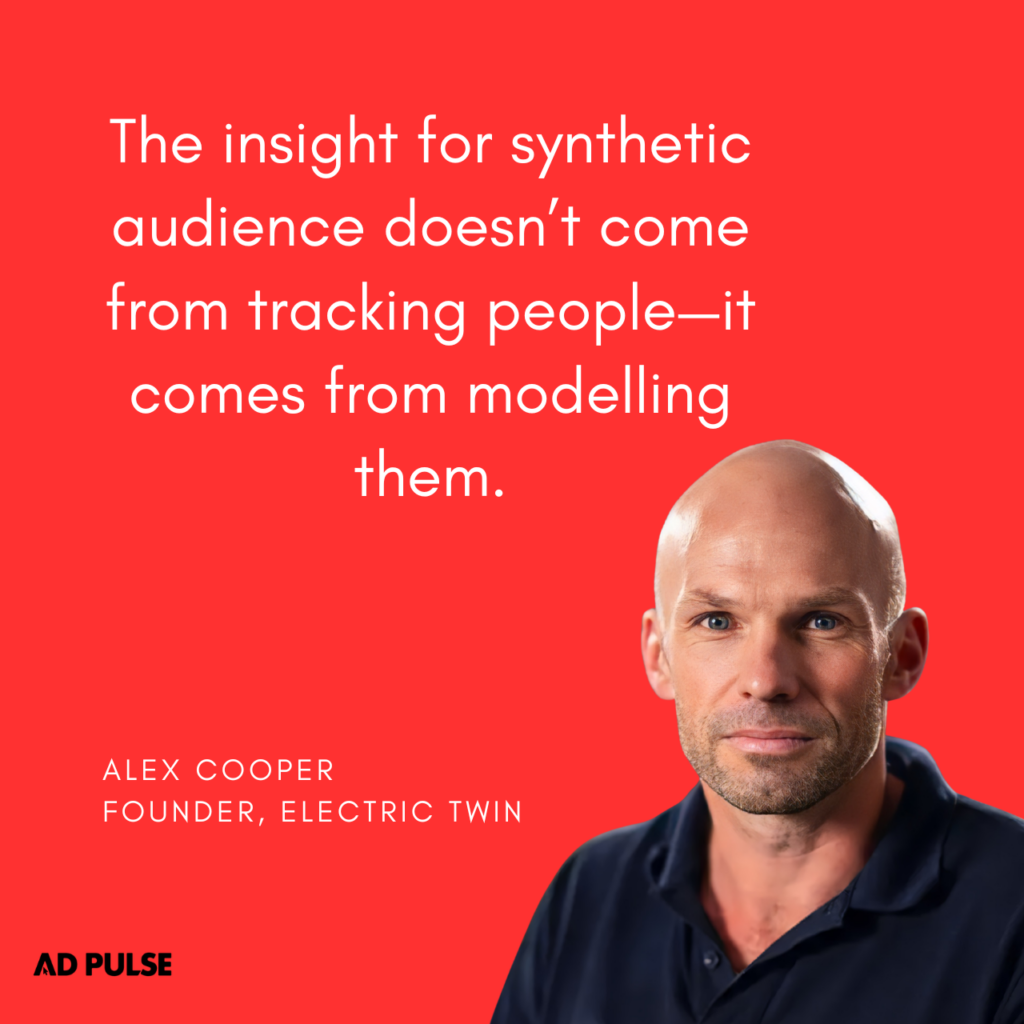
“The insight doesn’t come from tracking people — it comes from modelling them.”
Alex Cooper:
“Cookie deprecation and privacy regulations are both part of the same crisis. With these issues, you can no longer track what real people do across the web.
Even where you can, the regulatory risk of doing so is growing. Electric Twin sidesteps this entirely as synthetic audiences don’t require data collection from real individuals, so there’s no consent framework to navigate and no dependency on third-party identifiers.”
Rather than collecting new personal data, the approach relies on modeling behavior from existing demographic and contextual datasets.
Where Marketers are seeing the biggest impact
For marketing teams, the most immediate applications involve testing messaging, propositions, and positioning strategies.
Instead of debating internally which creative direction “feels right,” synthetic audiences allow marketers to simulate responses across audience segments.
“The real advantage is in scenario testing.”
Alex Cooper:
“The strongest early applications for marketers tend to be around message and proposition testing — understanding how different segments are likely to respond to variations in framing or positioning.
Our technology is also helping brands understand consumer preferences and decision-making patterns and assess public opinion on complex topics across audience segments.”
These insights can surface patterns that traditional surveys sometimes miss.
One example involved testing messaging for a hair loss product.
Alex Cooper:
“We thought men would be key users. It turned out that women were just as interested in the proposition.”
The difference, he says, often comes from the gap between what people say they will do and what they actually do.
Ensuring AI Models reflect real behavior
Predicting behavior through AI inevitably raises questions about accuracy.
Electric Twin builds its models using demographic and contextual datasets, generating synthetic personas that represent real populations.
Alex Cooper:
“We construct detailed synthetic personas based on demographic and contextual information using first- and third-party datasets. Each persona functions as an agent capable of responding to questions in ways that mirror real individuals from target populations.
We run accuracy evaluations continuously and achieve 95.5% accuracy on 1-MAE — the industry standard accuracy measure for comparing predicted and actual survey distributions.”
That accuracy rate is comparable to traditional research benchmarks, which typically average around 96 percent.
Media, subscriptions, and audience insights
Media organizations are also exploring synthetic audiences as a way to test editorial strategies and subscription models.
Companies including News UK are using the technology to explore how different reader segments might respond to pricing changes, content positioning, or advertising campaigns.
Alex Cooper:
“For media organisations, understanding audience response to editorial direction, subscription propositions, and advertising strategies is particularly valuable.
In a subscription-driven environment, even small improvements in conversion or retention forecasting can be strategically significant.”
The next phase of marketing research
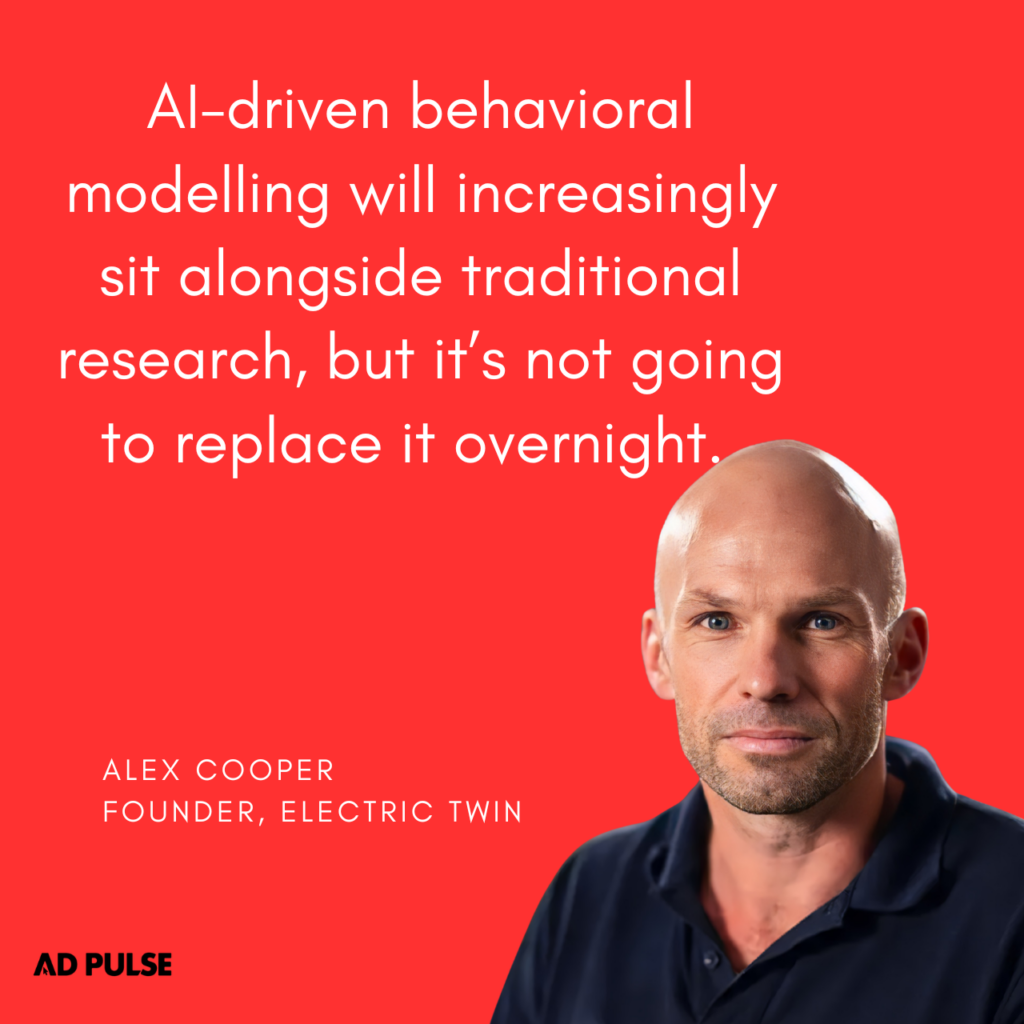
While synthetic audiences are unlikely to replace traditional research entirely, Cooper believes predictive modelling will increasingly sit alongside existing methods.
“It will feel less like a research activity and more like an always-on decision layer — a research agency in your browser.”
Alex Cooper:
“AI-driven behavioral modelling will increasingly sit alongside traditional research, but it’s not going to replace it overnight.
Decision velocity and the breadth of use cases will increase massively. We are currently working with an organization to test sixty variations of a product across tens of segments — something that simply isn’t possible using traditional research methods unless you invest millions.”
For marketers navigating an increasingly complex landscape of data restrictions and fragmented audiences, the ability to simulate consumer behavior before launching campaigns may become a powerful advantage.
And if Cooper’s prediction proves correct, synthetic audiences could soon move from experimental technology to a standard layer in the marketing decision-making process.