The Future of Search Ads: AI Just Broke the Funnel—Now What?
Remember the time when ‘searching’ merely required you to type words into a box to see if Google was able to find your answer? That era is quickly coming to a close. Today, with the use of AI tools like ChatGPT Search, Gemini, Perplexity, and Copilot, as well as the rise of answer-led platforms, the future of search ads is shifting rapidly.
Old-school SERPs are collapsing into an AI-powered, answer-first environment. Users no longer want to see “10 blue links”; they want answers, so they are more likely to use AI to help them. This shift in search has left PPC (Pay-per-Click) searching out of the picture and wondering how well it can adapt to this new search environment.
But the big question is whether or not traditional PPCs will be able to exist in this new world of AI searches, or whether we have officially entered into a new age of online advertisements.
Let’s break it down.
1: Algorithms evolved, but users evolved faster
The former version of search engines could be summarized by a very simple formula: user queries, search engine ads, user clicks, and user purchases.
Historically, the process of how searching worked was a linear evolution. With AI searching, you can now skip to the direct answer from the search engine without having to click through to the ad or purchase.
The popularity of AI searching means that user clicks are decreasing, but their intent will remain.
Having knowledge of what users are likely to be interested in will affect the order in which they see your advertisements.
2: The end of keywords and the future of context
The future will be focused on user context as opposed to individual keywords.
The user will no longer search for “running shoes,” but instead will use their own user profile to see what is available to them in that moment.
Subscribe to our bi-weekly newsletter
Get the latest trends, insights, and strategies delivered straight to your inbox.
Magic Words will become obsolete.
3: Ad placements get reinvented
Advertisements will have a new look in AI searches. Advertisements will appear as:
- Sponsored answers
- Recommended brands in summaries
- Product cards in responses
- Conversation starters (“Would you like a comparison?”)
In AI searches, expect:
- Fewer advertisements
- More premium placement opportunities
- More relevant results
Brands cannot “buy” ranking in AI answers; they must earn their way into the top results.
4: “Answer Ads” will replace pay-per-click ads
In AI searches, there will no longer be banner advertisements. There will only be recommendations in the form of:
- Native recommendations
- Contextual recommendations
- Transparent recommendations
- Algorithm-based recommendations
To qualify for recommendations, brands must provide strong metadata, clean data feeds, reviews and first-party signals. Brands that operate in an unethical manner will not receive recommendations from AI.
Advertisements based on user context and behavior will resemble programmatic buying more closely than standard PPC. When a user selects to view an ad because they have asked questions about knee pain and watched a marathon video, that will be used as the basis for your advertisement.
5: Zero-click search will explode
Artificial Intelligence Gives All The Answers In One Search Results Page.
Ads will need to be placed on the search results page, not above or below it. If brands do not adapt to the shift in how consumers search for products, they will become invisible.
6: New skills will be required for PPC advertisers
To be successful with PPC in the future, marketers must develop the following skills:
- Develop Strategies For Prompting Search Engines
- Optimize Signals And Feeds
- Use Conversational SEO
- Create Formats For AI-Ready Advertising
The goal should be to make it easiest for artificial intelligence to recommend your brand.
7: The era of cheap clicks has come to an end
Artificial Intelligence (AI) enables fewer clicks, thereby enhancing the level of quality.
Expect:
- Increases in CPC’s
- Increases in conversions
- Decreases in the number of impressions
- More targeted audiences
Quality over Quantity in PPC Marketing.
8: AI has a bias towards trusted brands
AI models review and analyze:
- Reviews
- Sentiment
- Returns
- Social Conversation
- Ratings
Big Brand(s) have an advantage, while Small Brand(s) must provide significant additional value for the following:
- Niche-based value to their audiences
- Excellent Review score
- High-Quality Content
- New & Innovative AI integration capabilities
9: Future of PPC?
Yes, it’s going to survive—it will evolve.
Traditional PPC will evolve into Impressions and AdSuite (AI) Intent Marketing 2.0.
What remains the same?
- Intent Ads
- Shopping
- Retargeting
- First-Party Targeting
And what goes away?
- Keyword “farming”
- Spammy “extensions”
- Obsessing over exact matches
What grows?
- AI-born “placements”
- “Recommendation” ads
- “Interactive” impacts
10. The future = Precision + personalization + prediction
The evolution of AI-based search engines is driving increased use of PPC towards:
- Micro-Moment Precision
- Ultra-Personalized Relevance
- Predictive Targeting
New Rule of Search Ads:
“Be the Answer”, not “Link to”.
Real-world examples to look for
What you’re seeing below isn’t theory; it’s the new reality of search. These shifts reveal exactly where ads are headed next.
Google is now showing advertisements in AI Overviews: Searches with Google AI Overviews in the U.S. have had advertisements placed within the AI-written summary instead of only at the top of the results, changing how advertisers get visibility with their ads.
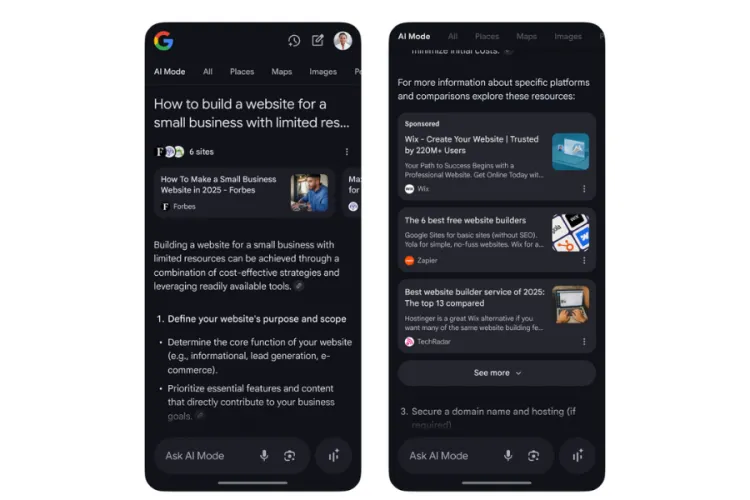
Google has added a new way of using AI Mode: Through Google’s AI Mode, tests have shown that advertisement listings appear within the chat-answer style and match with a suggestion, rather than the traditional pay-per-click listings.

Advertisers have seen a decline in CTR from using AI Overviews: So far, advertisers in the U.S. are reporting a decrease in click-on-rate from AI Overview searches, as they will receive answers straight away without ever having to click to another page to get them.
Cut to the chase
AI search has changed everything—keywords are already fading, context is the most important, and ads are now included directly in the answer instead of around it. PPC is undoubtedly here to stay; however, you will have to accept that there’s a new way of approaching it. If you would like to receive the entire Ad Pulse study, please comment below with “AI PPC,” and we will email you the link.