
Meta’s Scam Economy: Advertisers Are the Only Ones Who Can Stop It
Meta has been doing nothing but accepting revenues from the scams its consumers fall for. With more than a billion users operating two to three social media platforms—while innocently claiming to connect friends and families—and raking in millions and billions of dollars, Meta continues to think less of brand safety and trust.
And you know what’s most infuriating for advertisers in all of this? Meta can rectify these issues, yet it seems far more interested in stalling lawmakers and governments.
From Japan to the U.S., lawmakers have repeatedly directed their anger toward the social media giant over reported scam revenues and consumer losses. Yet nothing concrete has come out of it.
Meanwhile, Meta is keen on amplifying AI across its ad processes by launching Andromeda and Advantage+ suite. Earlier in 2025, the company effectively replaced agencies—the principals—from the cycle of selling and buying ad space on the platform. This marked a massive shift in Meta’s role and raised serious questions around transparency, media value, and neutrality in optimization.
As brands head into 2026, caution is no longer optional—for one core reason: consumer trust. To understand why, we need to look closely at what’s happening inside the Meta.
A tale of a 10-headed hydra: that’s Meta for advertisers
Jeff Horwitz of Reuters published a bombshell report revealing that nearly 10% of Meta’s ad revenue came from scam and fraudulent ads in 2024, according to internal audit documents.
After reading multiple reports and writing more than ten articles on Meta’s cases and controversies, one thing is clear to me: this isn’t happening in good faith. Meta’s behavior borders on self-destruction.
The greed—and the obsession with outperforming other billionaires or becoming the first trillionaire—is so extreme that Meta appears willing to let one-third of U.S. citizens get scammed in broad daylight.
U.S. senators, citing Reuters’ reporting, noted that Meta itself estimated its platforms were involved in one-third of all scams in the U.S. They further pointed to FTC estimates that Americans lost $158.3 billion to scams last year.
Billions in scam-driven ad revenue won’t be an issue for Meta—at least not until someone reports it.
Subscribe to our bi-weekly newsletter
Get the latest trends, insights, and strategies delivered straight to your inbox.
Technically, transparency exists. Meta’s public Ad Library is open and easy to access. Anyone can view ads running on the platform. But transparency here is largely performative—on display, not in practice.

Another disturbing Reuters report revealed that Meta attempted to stall regulators by creating a so-called internal “playbook” claiming to remove scam ads. In reality, the company merely reduced ad discoverability. A classic game of hide and seek.
Another ‘Expanded’ game Meta played
Meta ads operate across different tiers: Expanded, Moderate, and Safe.

Expanded is the “anything for scale” setting. Ads can appear next to a wide range of content, including edgy, emotionally charged, or borderline controversial posts that don’t explicitly violate policy. This setting maximizes reach, speeds up delivery, and lowers CPMs—but it also increases the risk of ads appearing beside content that can spark backlash, screenshots, or internal Slack meltdowns.
Moderate (or Standard) acts as Meta’s middle-ground safety net. It filters out the most sensitive categories—graphic violence, explicit content, and highly polarizing material—while still preserving reasonable scale. This is the setting most brands think they’re on, but aren’t, unless they actively select it. It’s designed for balance, not heroic.
Safe (or Limited) is the tightest leash. Ads run only next to clearly non-controversial, brand-friendly content. Risk is lower, but so is reach. Delivery slows, CPMs rise, and performance teams start asking uncomfortable questions.
Meta has effectively set Expanded as the default unless advertisers actively remove it.
Why? Because Expanded makes Meta more money and makes campaigns move faster. Everything else is window dressing.
Expanded inventory unlocks the largest pool of content, enabling faster optimization and cheaper CPMs. Meta’s ad system prioritizes scale and performance—not advertiser comfort.
If the default were Limited or even Standard, large chunks of inventory would be inaccessible. Delivery would slow, costs would rise, and advertisers would complain about inefficiency rather than brand safety.
Meta also knows most advertisers don’t touch brand safety controls. Campaigns are launched, published, and forgotten. By defaulting to Expanded, Meta ensures smooth delivery unless advertisers deliberately choose restrictions.
Meta has no real competition
Despite repeated negative experiences on Facebook and Instagram, there has been no meaningful user revolt. With platforms increasingly flooded by AI bots and AI influencers, Meta continues to sleep comfortably on safety enforcement.
I’ve written extensively about user dissatisfaction on both Facebook and Instagram.
During antitrust cross-examination, Tom Alison, Head of Facebook, admitted an uncomfortable truth about the platform’s existential crisis:
“Not everyone who joins Facebook these days does so to find their friends on the service.”
Tom Alison, Head of Facebook
After building a largely friendless Facebook, Meta knew AI would become its dominant force.
So, who exactly competes with Meta? With unmatched data access, billions of users, and third-party sellers flowing through its ecosystem—effectively making Meta a publisher—the competitive field is narrow, at best.
Advertisers are the real force to reckon with
Here’s the uncomfortable truth, Meta won’t advertise: advertisers could become its real regulators. Not lawmakers. Not watchdogs. Not users endlessly doom-scrolling past scam ads. Money talks—and advertisers are still writing the loudest checks.
Even if scam ads contribute an estimated $16 billion, the real engine of Meta’s revenue remains verified, repeat, brand advertisers. Strip away fraud, dropship scams, and crypto hustlers, and Meta still relies heavily on brands. That’s leverage—whether advertisers choose to use it or not.
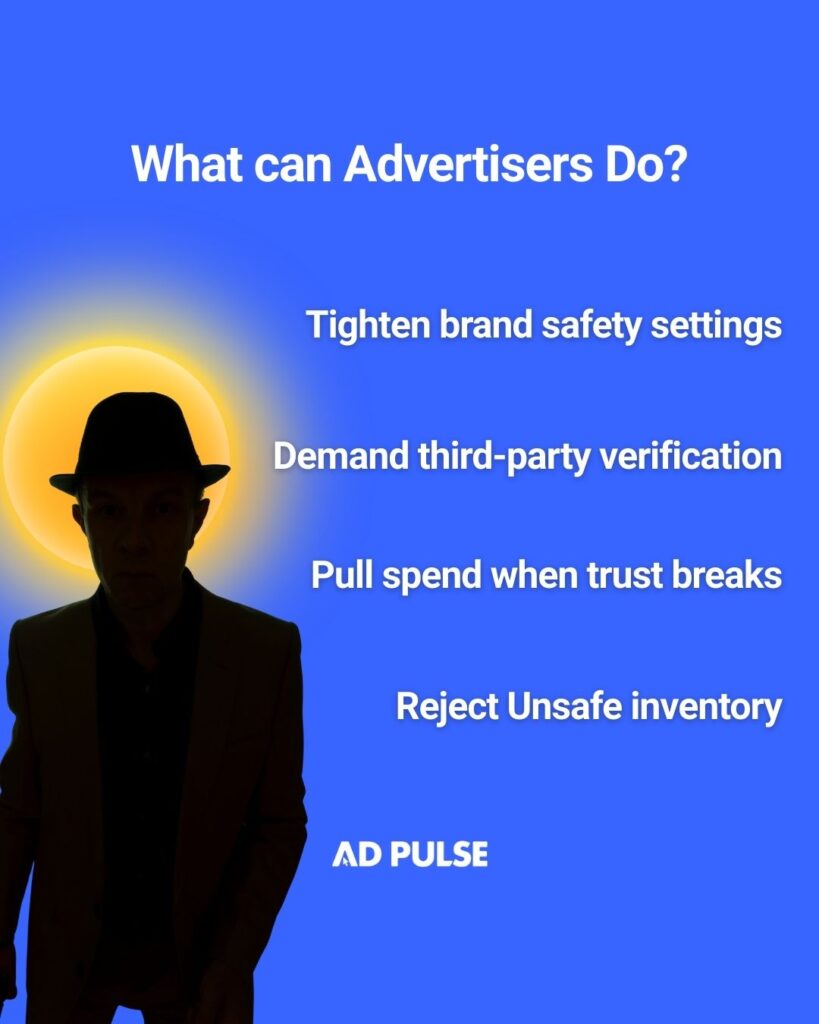
Advertisers already have the power to slow Meta down: tightening brand safety settings, demanding third-party verification, rejecting Expanded inventory, questioning AI-only optimization, and pulling spend when trust breaks. The issue isn’t lack of power—it’s a lack of collective spine.
Meta thrives because advertisers tolerate opacity as long as dashboards show performance. The moment trust becomes a KPI, not an afterthought, Meta’s “scale at all costs” model starts to wobble. Brands don’t need to boycott Meta. They need to discipline it.
Because if advertisers won’t draw the line, Meta never will.
Cut to the chase
It’s time to fight back against scams and fraudulent ads on Meta. Only advertisers can challenge the very system they use to reach millions. Allowing brand trust to erode simply because Meta doesn’t care enough about brand adjacency serves no stakeholder—brands, consumers, or the industry at large.