
Brand Budgets in 2026: Why “Do More with Less” Is No Longer a Strategy
For years, “do more with less” was marketing’s favorite coping mechanism. Budgets got tighter, expectations got bigger, and teams were told to stretch every rupee, dollar, or cent until it squeaked.
This cliché has come to an end in the year 2026.
Brands don’t just have reduced or increased budgets; they now have a different allocation of their budget. The brands that continue to think of budget cuts as a challenge to their creativity rather than an opportunity for a strategic reset are going to continue to suffer declining ROIs in a very quiet and slow way.
It’s not about how much you are spending; it is about how you are spending it differently than you used to.
In 2026, let’s break down what is actually happening with brand budgets, where the marketing dollar is flowing, and how marketing strategies that are focused on return on investment (ROI) will impact every line item.
The big shift: Brand budgets aren’t tight—they’re intolerant
Here’s a hard truth to swallow:
Most brand budgets in 2026 will not be “low” but rather very impatient!
CMOs are not being rewarded for intelligently managing costs, but for how much they deliver in measurable dollar amounts. Boards do not care how efficiently you ran a campaign; they want to understand what generated revenue, retained customers, and/or made the brand’s reputation stronger.
The real trend in the marketing budgets for 2026 will be:
- Fewer experiments were conducted for learning the brand lift.
- Lower tolerance for vague brand lift.
- No more time spent on platforms that cannot provide a measurable impact.
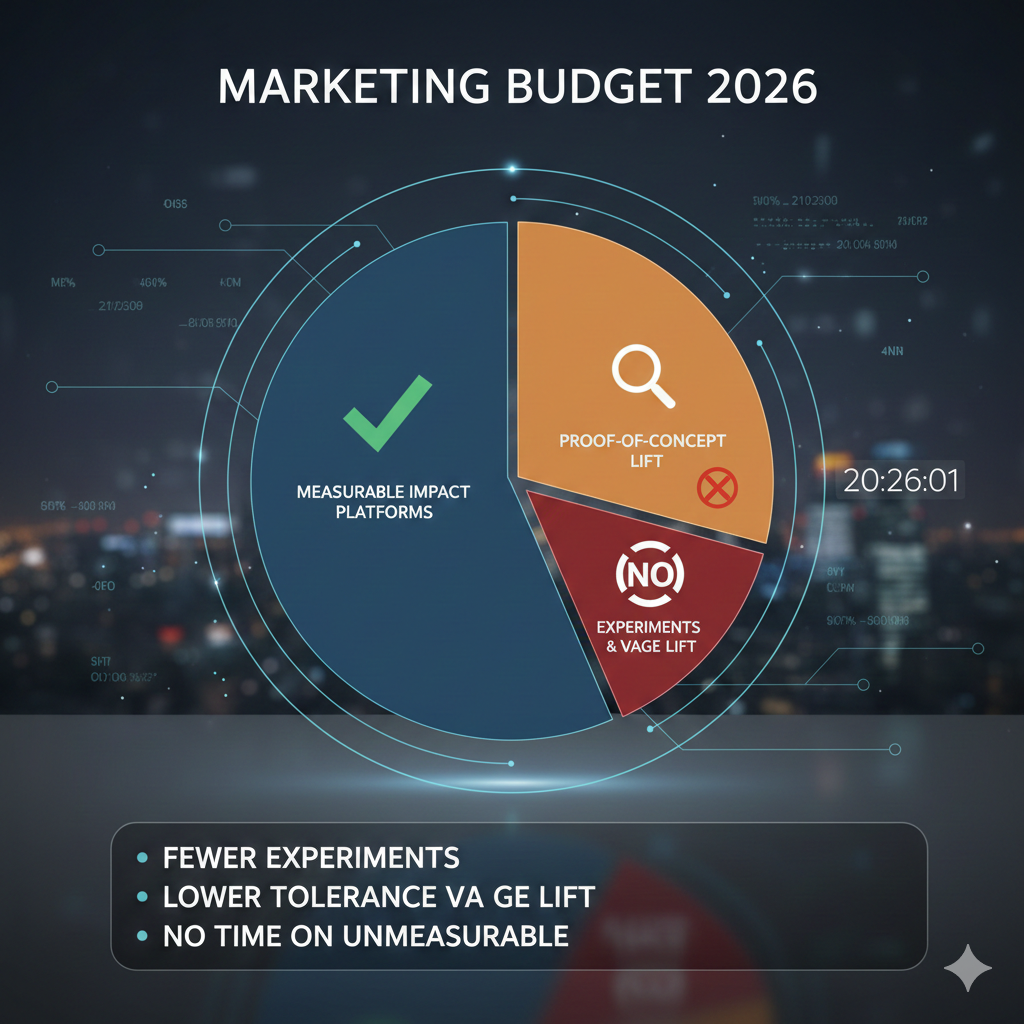
This goes beyond anecdotal evidence. Only a small minority of marketers anticipate budget cuts in 2026, whereas over 70% say they intend to grow them. This indicates that the focus has changed from cost management to ROI justification.
The trends in the marketing budgets will NOT be driven by austerity, but by accountability!
Subscribe to our bi-weekly newsletter
Get the latest trends, insights, and strategies delivered straight to your inbox.
Why “do more with less” quietly fails in 2026
The concept may seem noble. Hustle culture is present in the marketing world, but is causing significant harm in reality. Here’s why the old way of doing things doesn’t work anymore:
#1. Complexity has exploded
Today’s marketing focuses on:
- AI-assisted personalization
- Creator-based ecosystems
- Retail media networks
- Walled gardens
- Privacy-protected measurements
You can’t simply ask teams to “do more” whilst not providing tools, data, or partnership, as that will only result in executing just a surface.
#2. Efficiency without effectiveness will cost you
Inexpensive impressions, low-cost clicks, and bundled platform deals may look great on spreadsheets, but in terms of performance, they often fall short of what is expected in relation to actual ROI.
Brands are not losing money because they are spending too much; they are losing money because they are spending with no direction.
The marketing budget shift everyone is making (Quietly)
The marketing budget for 2026 demonstrates three obvious patterns if you take a step back.
#1. Moving away from volume-focused and more towards value-focused advertising
Reaching the masses isn’t what it once was, so brands are taking the money away from:
- Low-intention/high-frequency impressions
- Spray-and-pray programmatic buying
And are orienting towards:
- Contextual placement of their message
- High-attention media environments
- Signals-based targeting, as opposed to demographic-based targeting
Less total eyeballs to be reached, however more/safer/correctly targeted will be the goal of brands.
#2. Moving from platforms to performance ecosystem
In 2026, brands will look to outcomes rather than platforms for their loyalty. This could mean a reevaluation of spend on “always-on” channels, the removal of budgets from poor-performing social media channels, and reallocating to channels that demonstrate downstream impact instead of just clicks, etc.
Overall, digital marketing budgets are becoming more fluid. Dollars will move between channels based on performance signals on a monthly (or sometimes even weekly) basis.
If a platform cannot provide justification for its share of the budget, they will not be able to continue receiving it.
#3. The Shift of Ad Agencies to Brand Investment Partners
A major shift that has gone largely unnoticed is also one of the largest shifts in who brands trust their money.
Brands are moving away from the traditional vendor model and towards the brand investment partner model, which is comprised of teams that think like CFOs instead of just being creative teams.
The brand investment partners can do the following:
- Connect campaign activity with business KPIs
- Share risk through the use of performance-based pricing.
- Reallocate budgets dynamically to optimize ROI.
The message brands are sending to their partners is very clear: “if you cannot defend the spend, you are not a part of the management team”.
Where brands should spend marketing budget in 2026
Where do we spend our money? Brands are increasing their use of owned channels because of this. In a ROI-first budget climate, email marketing yields over $36 for every $1 spent, while SEO yields over $20 per dollar, making them some of the most defendable line items.
There isn’t a lovely answer to this question. It depends on the type of marketing you’re doing and how well you’re measuring your performance.
#1. Marketing that is driven by ROI (and not just performance)
While performance-based will always be around, the difference now is that we are measuring performance-based much slickly than before.
Brands are doing things like:
- Testing Incrementality
- Privacy Safe Marketing Mix Modeling
- Using AI-Led Attribution
This leads to answering the one question that is going to matter in 2026: What is going to be lost if I no longer have this budget?
If you can’t answer that last question, then what you’re spending is really on borrowed time.
#2. Owned Channels That Build Over Time
Brands are increasingly allocating resources to owned assets:
Email and messaging systems, Personalization based on CRM data, Communities that support brands Content that supports long-lasting discoverability
They are not exciting, nor do they trend on LinkedIn, but they help reduce reliance on inflation from paid media and are therefore very important in 2026.
#3. High-Trust Environments
As more false information and fatigue from advertisements, as well as noise from AI developed, brands have begun to embrace trust.
As a result, budgets are moving:
- Premium publishers
- Trusted creator partnerships
- Contextually aligned content environments
Once upon a time, optimizing meant making small changes; now it means reallocating your marketing budget and creating new ways of working with your team to accomplish that.
Budget reallocation is today’s optimization
Before, optimization was about changing creatives and changes in bids. In 2026, optimization has a different definition and has turned into budget reallocation.
Brands want to know:
- What platforms produce incremental growth?
- What channels are just recycling previous demand?
- What investments will grow sustainably rather than just showing visible growth?
This is why companies are having renewed interest in platforms that do budget reallocating and marketing ROI optimizing – not because they are new and shiny, but because they provide answers to difficult questions.
How to embrace smart brand budget strategy
Brands’ 2026 success in the budget department can be boiled down to 3 key traits:
#1: Less Experimentation and Greater Certainty: Fewer long-tail experiments, and more scale based on proven performance—with the opportunity to test but not to test forever!
#2: Measurement Before Scaling: Any channel will not be able to scale with no measurement framework in place from the beginning.
#3: Finance and Marketing are Finally on the Same Page: ROAS will not provide sufficient metrics by themselves. Contribution margin, lifetime value, and retention value are becoming standard marketing performance metrics.
Marketing is becoming greater and more financially integrated.
Cut to the chase
In 2026, the budgets for brands will not be about reducing costs, but about maximizing their effectiveness, with each dollar spent being based on a measurable ROI and having a clear impact on sales. Build your budget with an emphasis on performance, trust, and accountability – or take the chance of throwing your money away on something that does not produce real sales growth.
Brand budgets in 2026: FAQs
Brand budgets in 2026 are shifting due to higher pressure on ROI, rising media costs, and reduced tolerance for spending that can’t prove business impact.
ROI-driven marketing ties every budget decision to measurable outcomes like revenue growth, retention, or incrementality—not just reach or clicks.
Brands should prioritize owned channels, high-trust environments, and performance layers that clearly demonstrate incremental value.
Cutting spend without strategy often hurts growth; smarter brands focus on reallocating budgets toward high-performing channels instead of reducing overall investment.