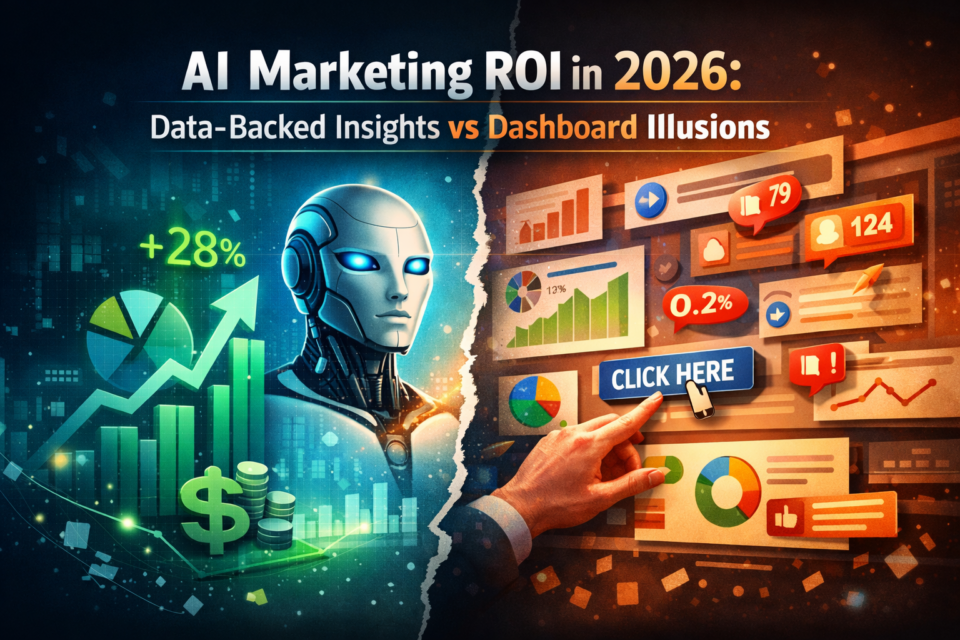
AI Marketing ROI in 2026: Data-Backed Insights vs Dashboard Illusions
For many years, AI ROI in marketing was treated like a “get out of jail free” card. As long as agencies and brands were “building,” nobody asked tough questions regarding AI. Dashboards remained cluttered, activity looked impressive, and automated actions were mistaken for progress.
However, in 2026, that grace period ended—with no more “free” passes. CMOs, CFOs, and brand custodians want proof. They want actual, defendable, and quantifiable ROI from implementing AI in marketing. So, what does the data say regarding revenue, performance, and growth generated by AI in marketing? Let’s take a look—what’s real and what’s the hype?
AI marketing ROI means something different in 2026
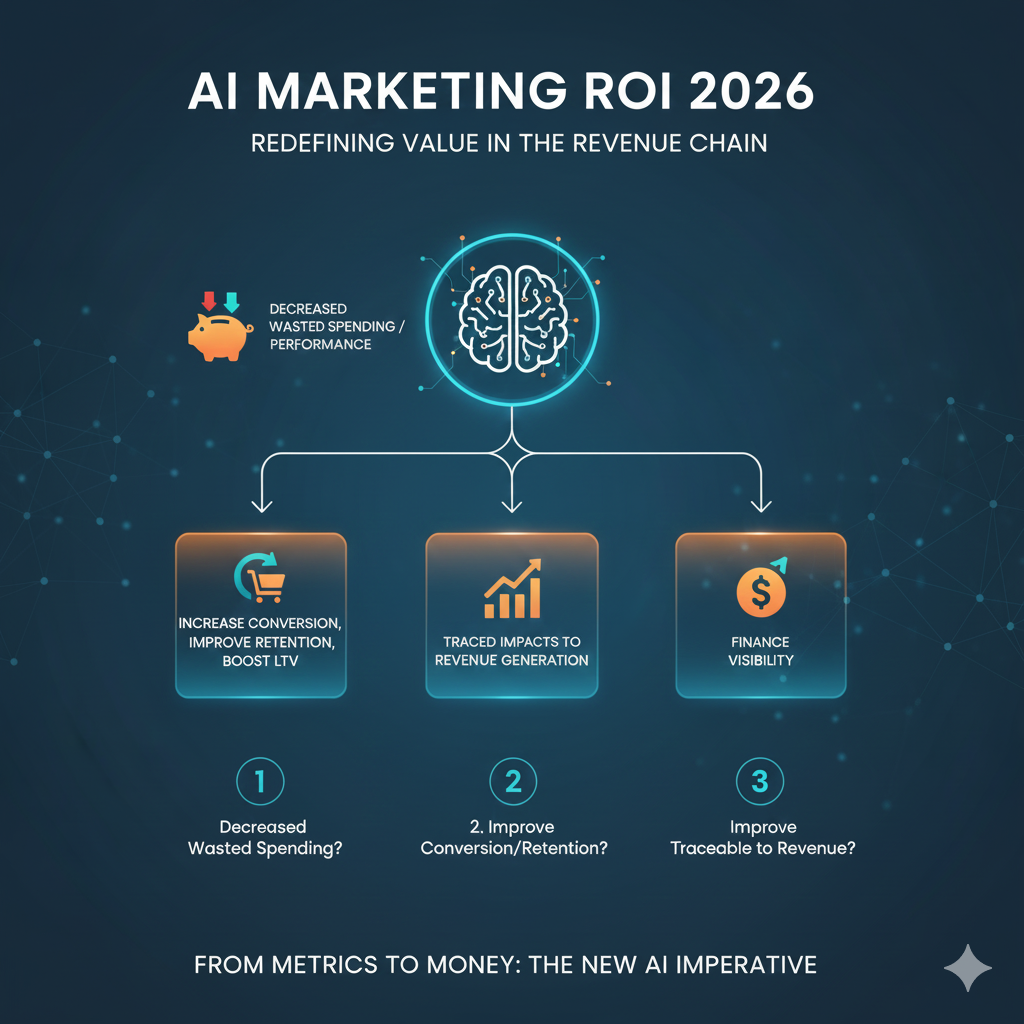
This is where most teams get it wrong. In 2026, AI marketing ROI is about where your AI tool sits in terms of the revenue chain. High-performance marketing teams have redefined their understanding of AI marketing ROI to include three main questions:
- Does the use of AI decrease wasted spending while maintaining or improving marketing performance?
- How does it help increase conversion, improve retention, or increase customer lifetime value?
- Will the finance department of a company be able to trace the impacts of AI on marketing back to revenue generation?
The mindset shift of high-performing teams is explained further in our article, Why Everyone is Fatigued with Ads (even the Good Ones), where it shows that volume is not equal to value anymore.
AI’s value isn’t in adoption—it’s in measurement
That’s only half of the story. Industry research consistently shows that by 2025, the value delivered by AI depends on how it is measured and implemented within an organization. The fact remains that the mere adoption of AI does not mean that your business has experienced a measurable business impact.
According to McKinsey & Company, the 2025 “State of AI” research report found that organizations that are leveraging AI on the customer-facing side of businesses (including marketing and sales) will show significant increases in revenue as a result of using AI. In other words, teams see real ROI when AI influences purchasing decisions and revenue growth—not when it’s limited to improving operational efficiency.
Similarly, Deloitte’s 2025 AI ROI research provides a more nuanced picture of AI investment and returns. The amount of dollars allocated to AI is rapidly increasing, as evidenced by the fact that 85% of companies are increasing their investment in AI solutions, and 91% of companies plan to increase their investment in the future.
However, there is an increased time frame and difficulty in quantifying ROI for AI solutions as compared to originally anticipated. Most companies are expecting to see ROI for their use of AI solutions over an extended time period (2-4 years) versus an immediate return. How much a company can grow its business using AI requires more than just the implementation of a technology solution.
Why efficiency isn’t ROI
Here’s what the data doesn’t tell you at first glance. This discrepancy clarifies why the concept of “Instant AI Revenue” still feels inconsistent.
When AI is used for a company’s revenue decisions (pricing, targeting, etc.), it creates a positive impact on such areas as growth. However, when AI is only utilized by marketing teams as a way of automating their work (as an addition to automated marketing), then the result will only be measured by how much more “efficient” their work has become rather than how much additional revenue has been generated.
Subscribe to our bi-weekly newsletter
Get the latest trends, insights, and strategies delivered straight to your inbox.
Bottom line: AI will create greater marketing success when AI is measured by revenue rather than simply “movement.” True ROI results will be accomplished when AI is used as part of the commercial decision processes, and the teams can agree on what the meaning of “success” is.
Where AI marketing revenue actually comes from
1. Better money management, lower waste
AI can now tell when a consumer is interested in making a purchase, instead of guessing. Top-performing teams are utilizing the following uses of AI:
- Estimating the likelihood of a purchase
- Allocating budget on the fly
- Suppressing ads to consumers who have no intent to purchase
These practices have led to lower customer acquisition costs. And increased operating efficiency while maintaining or increasing a brand’s potential reach.
2. Quality over quantity
By 2025 and 2026, the internet will be inundated with AI-generated content. And by 2026, the trend will be played out. The most successful companies understand the benefits of using AI to:
- Monitor which marketing messages generate revenue
- Recognize when a marketing campaign is losing its effectiveness
- Quickly eliminate poor-performing ad formats
For this reason, AI marketing analytics ROI becomes relevant—not because of how quickly it creates new marketing materials, but because it allows for greater accuracy in understanding where to focus marketing efforts. Having more content doesn’t equal better content. But having targeted content equates to better content.
3. Why AI matters more after the first purchase
Most marketers are still measuring AI’s effect on the top of the funnel. This is wrong. The actual financial contribution of AI to marketing will begin in 2026, after the first purchase is made (where retention, expansion, and lifetime value are determined). However, the most significant gains from using AI can occur in the areas of:
- Churn predictions and predicting future risk
- Creating personalized renewal/retention offers
- Providing AI-timed cross-sell and up-sell opportunities during the customer’s journey through the CRM
If AI is integrated into every aspect of the customer journey (not just acquiring customers), AI moves from being solely a campaign-focused tool to being a growth driver for the company. In other words, it goes from optimizing click-through rates to driving long-term revenue.
Remember, if you want to succeed with AI in your business, think about how to utilize AI at all stages of a customer’s journey (not just acquiring customers). AI can make your marketing more efficient and effective than ever before.
AI tools vs. revenue: The missing link
In 2026, reality is obvious. AI revenue vs. dashboards is a real problem. Dashboards don’t equal actual revenue. The use of AI tools has led to metrics showing higher levels of engagement, newer attribution, and model scores. However, they do not measure the transactions that finance teams care about. For example, finance departments want to see if their sales and margins increased or if their payback periods were shortened.
The difference in the metrics produced by AI tools has created a gap in how brands could utilize AI tools. Most AI projects lose momentum after the pilot phase because the majority of brands that are realizing revenue are looking beyond the metric measurements of their dashboards. They are now focusing on testing for incrementality and conducting regular audits to see how well their AI tools work and what the AI can do to help them increase their revenues. Without being able to calculate the economic value of AI, records and financial budgets are lost quickly.
Cut to the chase
An AI strategy that looks impressive on dashboards but can’t prove revenue impact won’t survive 2026. Winning brands measure AI in dollars, not impressions—and use it to make real commercial decisions. The real question isn’t if you use AI; rather, it’s whether your AI can genuinely demonstrate its return on investment.
AI marketing ROI: Your most-asked questions answered
AI marketing ROI measures how artificial intelligence contributes to revenue growth, cost efficiency, and decision quality—not just automation or engagement.
Leading brands use incrementality testing, revenue attribution models, and lifecycle value analysis instead of relying only on dashboards.
Confusing activity metrics with business impact. Dashboards show movement; revenue shows truth.
Yes—but only when AI is directly connected to revenue-driving decisions like targeting, pricing, personalization, and churn prevention.
AI delivers strong ROI when paired with first-party data, transparent models, and finance-aligned measurement frameworks.